

Tintin Yang Reviews a Lyric Memoir and a Novel for EVENT 54/3
Tintin Yang Reviews:
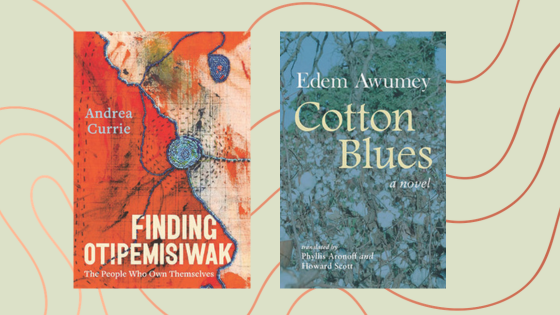
Andrea Currie, Finding Otipemisiwak: The People Who Own Themselves, Arsenal Pulp Press, 2024
Edem Awumey, Trans. Phyllis Aronoff and Howard Scott, Cotton Blues, Mawenzi House, 2024
Both Finding Otipemisiwak and Cotton Blues, through the different formats of lyric memoir and novel, are elegies that demonstrate the human costs of colonization and expropriation. By examining humans’ attempt to control the land, both Andrea Currie and Edem Awumey consider how capitalism not only demands the removal of Indigenous people from their lands and culture but also necessitates global systems of trade, consumption and finance, creating the material basis for the human and environmental exploitation that pervades and shapes contemporary life. Currie’s memoir takes place in the landscapes of the Western prairies and along the Atlantic coast, the homeland of the Red River Métis and the Mi’kmaq people, while Awumey sets his novel in Berlin, Germany, the Southern United States and the Sahel of Africa. Though these geographies could not be more apart, when taken together they suggest the inherent interconnectedness of class struggle and the making of difference in the face of global capitalism and colonization.
In Finding Otipemisiwak, Currie traces her experience of cultural dis-connection and later Indigenous reclamation as a survivor of the Sixties Scoop. A Métis child adopted into a white middle-class family in Winnipeg, she weighs the class position offered by her adopted family and their well-meaning—albeit violent and flawed—attempts to rear children whom they didn’t know how to love. In one particularly striking scene, Currie recalls a moment in childhood that encapsulated the contradictions of her experience as an Indigenous adoptee. Wearing a beautiful, warm wool coat, her younger self encountered a group of Indigenous children wearing tattered sneakers, which were encased in plastic bags in an attempt to be made waterproof in the harsh Winnipeg winter. She acknowledges it was pure ‘chance’ that she was the ‘the one with the warm coat on; it could just as easily have been [her] with the plastic bag-lined sneakers.’ For her, the contrast is palpable and unsettling.
The comparisons continue between Currie and her brother, Rob. Adopted into the same family, Rob received the brunt of their mother’s violent outbursts. Currie writes, ‘Over and over again, Rob absorbed the blows of abandonment…Rob and I grew up with that sharp blade held against our hearts, under the ice-cold gaze of our mother’s pale-blue eyes.’ Currie writes deftly and with earnestness as she recalls the challenges of growing up in this context, and she sees how she might have easily led a different life, perhaps one similar to Rob’s, who endured poverty and isolation. Going through a divorce and suffering from a workplace injury, Rob was later diagnosed with cancer and sepsis. While these later events were difficult and life-altering, Currie goes deeper, identifying how his unresolved childhood trauma, experience with medical racism, and lack of support networks created a constellation of circumstances that caused his death. Reflecting on her different trajectory, Currie credits the opportunity to connect with community, and therefore Indigenous culture, as life changing:
Community is where we experience it all. Community takes me to the depths of myself, inspires me in immeasurable life-giving ways, stretches the breadth of my capacity for love and resistance and healing and humour, and yes, sometimes it brings me to my knees. Community grounds me in who I am as an Indigenous woman.
As part of her journey of cultural reclamation, Currie eventually ventures to meet her biological mother, Maman. Again, she contrasts her experiences with her adopted mother, Irene, and with Maman. Currie names ‘cultural blindness’ as contributing to the distance she feels toward her adopted family, as they were incapable of seeing beyond their dominant cultural context and truly understanding her. Maman serves as an antidote to this cultural dislocation, sharing with Currie important details of their proud Métis lineage, even if she was an imperfect mother. Irene was abusive, but during Maman’s bouts of neglect and instability, she managed to provide the kind of stability that only class privilege can offer. While these two families couldn’t be more different, Currie demonstrates the parallax existences of people living in a nation haunted by ongoing settler-colonialism.
If Finding Otipemisiwak develops a narrative and critique of how individual lives are shaped by colonialism, Awumey’s novel Cotton Blues reflects the global systems that necessitate the theft and expropriation of land inherent to colonial capitalism. Connecting the expropriation of land and the exploitation of slave labour in the American South to the global regime of international finance, Awumey looks at how the global cotton trade has led to the rise of powerful multinational corporations, which have profoundly influenced the lives of farmers in Western Africa. Producing goods largely for consumption by the so-called Global North, farmers are devastated by unsuccessful growing seasons, which saddle them with debt. In Cotton Blues, Toby Kunta, an aggrieved cotton farmer, takes a young journalist hostage in the Museum of the Green Revolution in Berlin. Kunta detests the Green Revolution, which describes the expansion of the cotton industry in Western Africa due to the export-oriented economic conditions forced upon it by the Global North, and he intermittently burns photographs of cotton farmers as he taunts his hostage and the authorities who demand his surrender.
During this tense ordeal, Kunta looks back on his life and what brought him to Berlin while Robinson, his hostage, recounts his grandfather’s life and career as a painter. Kunta’s story and motive, his trajectory to this fateful evening in the Museum of the Green Revolution, are clearly depicted, but Robinson’s character is underdeveloped, and it’s not abundantly clear how Robinson and Kunta are brought together besides through a mutual connection, the museum’s curator. This murkiness thankfully doesn’t detract from the novel’s central aim, which is to highlight the power of Western multinationals and their disastrous effects on the working class of the so-called Global South.
Short of purely being an anti-imperialist freedom fighter, Kunta reveals throughout the novel that his political stunt is guided in part as a scheme to win back his American ex-girlfriend, Ruth. Kunta recalls their relationship and how Ruth’s political outlook influenced his own. It is eventually revealed that the two met at a protest Ruth organized against The Firm, the company that sells and produces the cotton seeds and pesticides used by farmers like Kunta. Ruth suggests there’s a way of escaping the tyranny of The Firm, yet a simple exit is not possible for the debt-ridden Kunta. Instead, he absorbs the knowledge that The Firm’s pesticides are harming the environment and that biodiversity is being destroyed by monocropping; he begins to understand himself as a serf and not the ‘bourgeoisie of cotton,’ as sold to him by The Firm.
In the opening lines of Cotton Blues, Awumey forges a connection between enslaved people in the Americas, those living on the shores of Africa and those enduring the Middle Passage. He writes:
One day I will have to accept the fact that all I possess is a miserable body and not what you could call a land of my own, a country, a home. I looked at the photograph given to me one day by an old man in a godforsaken town somewhere in Liberia. I looked at the photograph of the scrawny, sickly body and bruised back of Samuel Brown. Samuel flogged to death by Mr James Hoogan, the disciplined overseer, one morning in the year 1850 under a beautiful sun in a cotton field of Alabama.
Awumey skillfully reveals how the new world is born from the old. Today’s cotton fields in Burkina Faso involve the brutal exploitation of farm workers, echoing the deadly working conditions of those once enslaved in the United States. Admittedly, the novel’s shifting geographies and settings are at times abrupt, though they still serve the purpose of showcasing the expansive reach of the global cotton industry.
Together, Currie and Awumey speak to exploitation, racism and poverty as critical components of today’s modern economy. After reading Finding Otipemisiwak and Cotton Blues, I am reminded how the mundane and seemingly myopic reflect the broader structures that inform the conditions that make life livable for some people and disastrous for others.
— Tintin Yang