

Avery Qurashi Reviews Fiction from Clea Young and Catherine Bush for EVENT 54/3
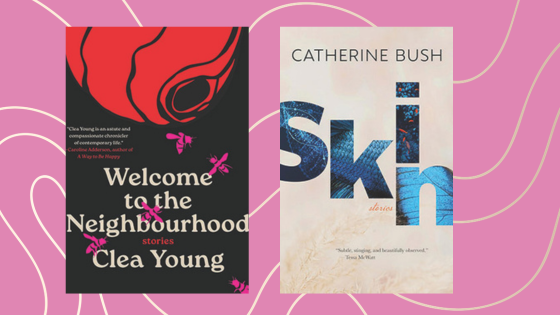
Avery Qurashi Reviews:
Clea Young, Welcome to the Neighbourhood, House of Anansi, 2025
Catherine Bush, Skin, Goose Lane Editions, 2025
In the final chapter of Precarious Life: The Powers of Mourning and Violence, Judith Butler explains the centrality of the face in Emmanuel Levinas’s system of ethics:
To respond to the face, to understand its meaning, means to be awake to what is precarious in another life or, rather, the precariousness of life itself. This cannot be an awakeness…to my own life, and then an extrapolation from an understanding of my own precariousness to an understanding of another’s precarious life. It has to be an understanding of the precariousness of the Other.
For Levinas, it is not empathy, which implies inhabiting another’s perspective, but instead the recognition of another person’s difference, along with their vulnerability, that induces a ‘rupture’ that binds together precariousness and peace. Butler explains that ‘the face of the other in its precariousness and defenselessness’ represents ‘at once the temptation to kill and the call to peace, the “You shall not kill.’’’ As it offers a framework for us to simultaneously recognize the vulnerability of other people along with an obligation to abstain from harming them, this Levinasian notion of the face presents a site at which we are called on to care for others in their precariousness.
Clea Young’s Welcome to the Neighbourhood and Catherine Bush’s Skin present complex characters who grapple with Levinasian ‘ruptures’ as they come face-to-face with vulnerable students, children, friends, lovers, colleagues and neighbours (both housed and unhoused), as well as non-human Others. In their engaging collections of short fiction, Young and Bush thoughtfully detail quotidian encounters with precariousness as they present their readers with imperfect protagonists who occasionally stumble as they attend to the vulnerability of other people and the natural world.
Welcome to the Neighbourhood comprises 13 stories that focalize female characters, many of whom are in caring positions as mothers, grandmothers and care workers, who explore ethical grey spaces in their encounters with vulnerability, particularly with disabled Others. The narrator of ‘Crows, Kittens, Mint Juleps’ looks back at a summer in which she and her friend stoked their adolescent fascination with disability by performing for a house-bound young woman nicknamed ‘Beatrice.’ Beatrice would regularly watch the girls from her own apartment’s window, participating in a circulation of gazes that the narrator characterizes as a form of play: ‘we were still children, after all, and Beatrice, childlike also, presented us with a game.’ Like many of the stories in Young’s collection, ‘Crows, Kittens, Mint Juleps’ emphasizes instances of looking and being seen. Throughout the collection, surveillant and scopophilic glances between Young’s characters create a complex optical ecosystem in which ordinary life becomes spectacular.
‘In Loco Parentis’ presents a self-doubting protagonist who, under the gaze of strangers, must decide how best to help an autistic child in her care when things go awry. In determining what is ‘right,’ Teja, an educational assistant, takes into account not only the child’s well-being but also the optics of her actions both within the school community and under the gaze of mothers at the park. While ‘Fungi’ similarly centres a care worker who is professionally responsible for attending to the vulnerability of others, ‘The Intruder’ and ‘Welcome to the Neighbourhood’ bring these encounters with vulnerability closer to home. ‘The Intruder’ begins when the narrator finds a barefooted stranger standing in her kitchen. Imploring the narrator to help her, the stranger offers a simple explanation for her presence: ‘“I wasn’t thinking. I just needed a place to go…Need a place to go.”’ The narrator sits awkwardly with her own discomfort, ashamed of her privilege while hesitant to meaningfully help the stranger in need. ‘Welcome to the Neighbourhood,’ the final and titular story of the collection, similarly narrates an encounter with someone who needs a safe place to go. Erik lives with his family in a strata ‘on a quiet street with a woodland view.’ While Erik and his wife are largely unbothered when a tent appears at the edge of the neighbouring forest, two new residents decide, at an impromptu dinner party, to accost the tent’s owner. Erik trails after one of his dinner guests, fearful the latter may go too far. Erik questions his own ability to intervene: ‘If called upon to act, to actually do something, will he?’
Through an ensemble of multi-dimensional characters who falter in their encounters with vulnerable others, Welcome to the Neighbourhood ultimately asks what it means to live in a community. Living among neighbours can invite surveillance, gossip and competition. It also brings us into intimate contact with the vulnerability of those around us. As the collection unfolds, Young slowly expands the scope of her stories’ theorizing on vulnerability and care by opening up space to sit with the vulnerability of animals and plants in our midst, as well as nature more broadly.
Catherine Bush’s collection Skin similarly offers thoughtful responses to the provocations that it opens up through encounters with vulnerability. The collection begins with ‘Benevolence: An East Village Story,’ a novella narrated by Ellen, a substitute high-school English teacher. When a student confides to Ellen that his living situation feels precarious, she, with the carefully sought approval of the school principal, invites him to move into her apartment’s second bedroom. Wary of her own motives, Ellen takes care to dilute the intimacy of sharing her home, while she continuously placates her anxiety by revelling in her own benevolence. Years later, she reflects, ‘I tried to hold onto my feelings of benevolence the way one might hold onto a lover. To swallow altruism like a drug.’ As the story progresses, Ellen continues to interrogate her own act of kindness, adapting Hamlet’s famous query to ask, ‘To be too kind or not kind enough?’ As Ellen fixates on this question of kindness, she unwittingly demonstrates that kindness is a malleable idea, which, despite her best intentions, she moulds to clarify the murky ethics of her seemingly benevolent act. Ellen gently plays with this malleability, while never fully acknowledging it, as she contemplates how and if to continue her cohabitation with her student-turned-roommate.
The stories in Skin tenderly explore moments of crisis—breakups, chemical attacks, extreme weather events and debilitating headaches—to expand a space of contemplation that ‘ Benevolence: An East Village Story’ opens up as they ask their characters how to respond to the needs, pain and precariousness of others. At only one-and-a-half pages, ‘Mortals’ presents its protagonist with an ethical dilemma when she spots an unidentifiable figure on the side of the road. Unsure if the shape belongs to a person, creature, object or angel, she pulls over her car to see if she can help. When she sees that the figure is a broken-winged bird, she considers her next move: ‘She stopped. How best to approach it. Turn away. No. She stooped at the bird’s side. One round, panicked eye met hers. The ragged, flapping wing—this was what she longed to touch.’ In this moment of rupture, the bird presents the protagonist with an ethical appeal through meeting her gaze.
As Skin turns toward exploring our connections with, and moral obligations to, non-human others, its protagonists engage with the question of how to live in relation to a precarious Earth. After being violently assaulted for his environmental advocacy, Hugh, the protagonist of ‘Derecho,’ leaves his research job and takes up a slew of new hobbies, including storm chasing. Toward the story’s close, Hugh feels an ‘ extraordinary alertness’ as he stands in the middle of a windstorm. Communing with the wind, he considers the question of how to relate to the natural world: ‘How best to be alive amidst whatever was happening—this was the crucial question, the singular urgency that drove him onward.’ In ‘Glacial,’ a tourist on an Arctic expedition carves out time to be alone with her surroundings. She asks of the air, ‘How am I to be in this landscape?’ as she listens to the glacier, ‘open[ing] herself to…[an] encounter’ with the otherworldly mass of ice. As Skin draws toward its conclusion, its focus becomes increasingly ecological, exploring how we are vulnerable to our environment, which in turn is vulnerable to us.
Both Welcome to the Neighbourhood and Skin explore questions of how to respond to vulnerability. While Welcome to the Neighbourhood uses sight as a vehicle of encounter, Skin presents touch as a means through which to connect and engage with other people and the world around us. These engagements with physical sensation draw our attention to the boundaries of the self and other people, as they simultaneously present moments of rupture when these boundaries, for a moment, fleetingly dissolve. Young’s and Bush’s collections present deeply human characters whose encounters with vulnerability demonstrate life’s precariousness and, in the spirit of Levinasian ethics, that we are equally capable of harm and care.
— Avery Qurashi