


Sumaiya Matin Reviews Two New Short Fiction Collections for EVENT 54/3
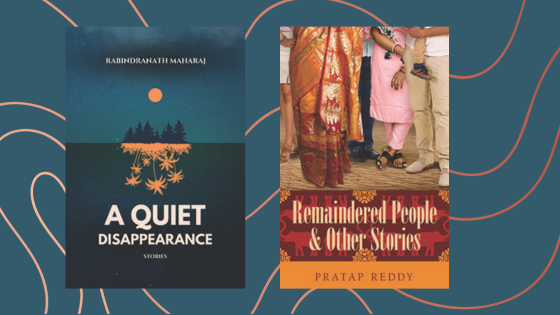
Sumaiya Matin Reviews:
Rabindranath Maharaj, A Quiet Disappearance, Mawenzi House, 2025
Pratap Reddy, Remaindered People & Other Stories, Guernica Editions, 2025
Rabindranath Maharaj’s collection A Quiet Disappearance includes 17 stories centred on characters of Caribbean descent who have migrated from or returned to Trinidad. The first story, ‘A Quiet Disappearance,’ is told from the perspective of a young man witnessing his father’s eventual return to the island. He describes his father as a watchman, with ‘a wary look pinched into his slim face, his jaw set, and his nostrils seeming to tremble as if he was sniffing out danger or defiance.’ In the last story, ‘Jahaji Bundle,’ we gain insight into the father’s journey to that decision as well as his feelings of estrangement toward his own family members after migrating:
Raj…viewed his family as ungrateful, not towards him but to their island. He noted how swiftly they had adopted other ways of speaking and dressing, and if he were not so tightened with dismay during these early months, he might have realized that he was angered less by these acts of assimilation than by the conviction that his family had refused to suffer with him…he felt as if he was talking to strangers and he stumbled…He became a watchman. A silent witness to the daily transgressions.
While Raj, the father, sees himself ‘growing smaller and more irrelevant with each observation,’ his son reflects on ‘never [having had] time to grow scales’ because his parents were ‘too consumed by their own struggles.’ The placement of these two stories creates a bookending effect. The ending returns to the beginning, and while closure remains elusive, each offers a view of the tensions that arise from generational differences in the migrant family.
Maharaj plays on a double meaning of ‘a quiet disappearance,’ which, for the son, speaks to ‘a blank slate where there should have been joy.’ For the father, these words connote comfort. When he returns to Trinidad, he describes himself ‘disappearing quietly into an old [life].’ The images are evocative—both father and son do not know each other’s truth as they slowly disappear from the other’s life.
Maharaj acknowledges cultural dislocation and the pressure to assimilate, but his collection deviates from the traditional migrant narrative, which tends to depict a newcomer finding self-acceptance and/or conventional success. Instead, it offers a meditative unfolding, where family dynamics and characters themselves undergo subtle and emphatic shifts. Maharaj delves into the margins where older migrants are also grappling with deeper questions about purpose, meaning and death alongside their quest for belonging in a new place. His exploration of aging is striking, particularly the shifts in self-perception that come with changes in memory. In ‘Decades,’ the unnamed protagonist prepares for each upcoming decade of his life by purchasing items he anticipates needing, the thought behind each acquisition extensive. His children, preoccupied with their own lives, ‘assumed his hoarding was emblematic of all the old men who lived alone. They showed no signs of curiosity in any case.’ During the protagonist’s final moments hooked up on a hospital bed, his consciousness travels to various memories. As his physical brain changes (‘perhaps because of the anesthesia or because his syn-apses had begun to misfire’), his consciousness redirects from usual recollections of events to ‘a crowd lurching from a foggy valley’ and the unpleasant faces of his ‘former family,’ ‘ segments of the past…[that he had] learned to forget.’ As he does this, his children at his bedside look at him as ‘a stranger, and they [wish] they could be somewhere else.’ When the nurse utters ‘Thukdam,’ which is a state in Tibetan Buddhism when consciousness remains in meditation even after clinical death (a high level of spiritual attainment), his daughter only hears a sound like an ‘impatient drip of water in a tubular cave.’ In the final moment of the protagonist’s departure from the world, I, too, could not help feeling some relief, except only from his growing isolation in a material world. He describes this isolation at the start of his fifth decade of life as ‘tiny pebbles bubbling close to his skin’ that ‘fitted him like a threadbare jacket.’
The departures of Maharaj’s protagonists—whether from lands, homes, relationships or the world itself—are haunting. In fact, at times, living feels like a slow process of dying. Portrayals of final departures stir questions about imprints of the soul post death. In ‘The Teak Toy Trunk,’ a woman who made a ‘hasty and unplanned escape from the island’ grapples with the loss of her daughter to a shooting outside a club. When her daughter’s father, presumably her former partner, visits from the island to reconnect, she’s prompted to reflect on her decision to leave years earlier. What would have happened if she had chosen to remain? Death and grief ignite private assessments of the self: who one was and has been, relations that could have been, regrets.
In ‘Senor Sewerpuss and Glamourgoat,’ Mr. Wardle, a recently fired newspaper writer, interviews a grieving mother for an online article. After learning how she lost her influencer daughter to suicide, he notices changes in her and himself. He concludes, ‘ The departed never really disappear. They hang around as imagined spirits, constantly reanimated by what they have left behind, their lives extended by our grief and desperation…’ Whereas death is a continuation of sorts—a comma—in this story, it is a period in ‘The Halfway Indian,’ in which Mitra, an elderly relative of the protagonist, struggles with an internalized sense of inadequacy. Despite all his education and his previous privileged position as a government statistician, he airs his prejudices about racial groups and the migrant struggle like a ‘jaded philosopher.’ It is only in death that his lifelong battle comes to a stop: ‘Migrants never decloak themselves of their anxieties…They believe they can swing, like on a hammock, between two places. Everything must come to a stop, you see.’
In Maharaj’s collection, departures such as death are not just literal or physical. They also represent dislocation and disconnection from identities, other people or the land; in some cases, they also mark a return. Cumulative losses in the undercurrents of life float into view for characters as they reckon with mortality. Silence or the unsaid symbolize the death of possibilities and connections.
The emotional texture of Pratap Reddy’s 15 short stories in Remaindered People & Other Stories recalls van Gogh’s impasto technique: he paints the emotional world of his characters with distinct brushstrokes. Separations, cultural dissonance, discord between generations, unmet expectations and personal loss lead to emotional ruptures. Characters’ experiences are contextualized in the larger migrant struggle against systemic and cultural barriers.
In ‘Sweet Memories,’ a woman is brought to Canada on a long-term visitor’s visa by her son after he suspects she is in the early stages of dementia. Locked in a basement for safety reasons, she recalls her past life:
She chuckled at the old photographs…There were so many pictures, so many faces with smiles frozen on them. It was as if there was no place for grief in her album…Then she stopped turning the pages and frowned. There was something she was supposed to do… She groped in her mind but couldn’t put a finger to it.
Like Raj in ‘A Quiet Disappearance,’ our elderly protagonist looks at photographs as an anchor for self-perception. She looks backward when struggling to look forward, due to her eroding memory but also a sense of meaninglessness. Just as Raj does, she begins to vanish, both literally and physically, from her children and those taking care of her. Reddy grounds this growing distance in a systemic reality: his protagonist doesn’t qualify for state medical insurance, which limits her freedom. The claws of time and disease spare no one, and our material realities complicate matters.
Reddy’s humour differs from Maharaj’s, as it’s more direct, playing on irony and subverting expectations. In ‘Remaindered People,’ an unemployed man agrees to live with his friend’s father who lives in Hyderabad, India. He plans to write a blog about his time in the house, particularly the gradual decline (and eventual death) of the old man, only to have his own brush against mortality.
Reddy’s exploration of death is rooted in religious and cultural practices, adding layers to the protagonists’ experiences and symbolism to the narrative. In ‘Carrion Birds,’ relatives of a deceased woman await news of potential inheritances after a cremation. Meanwhile, offerings are made to crows, a Hindu ritual for honouring ancestors and cleansing karma to bring prosperity and blessings into the household. The guests are tortured by the news that most of the inheritance is going to servants, and tortured too by their own hunger—they cannot eat until the crows have.
As in Maharaj’s collection, the characters in Remaindered People are grieving loss—of their cultural practices, social roles, expectations or personal agency. They, too, are moved to reassess or change their trajectories, even if the endings to their stories are often open-ended. Both collections offer poignant meditations on overlooked lives, such as those of the elderly, and explore the many nuances of the migrant experience.
— Sumaiya Matin