

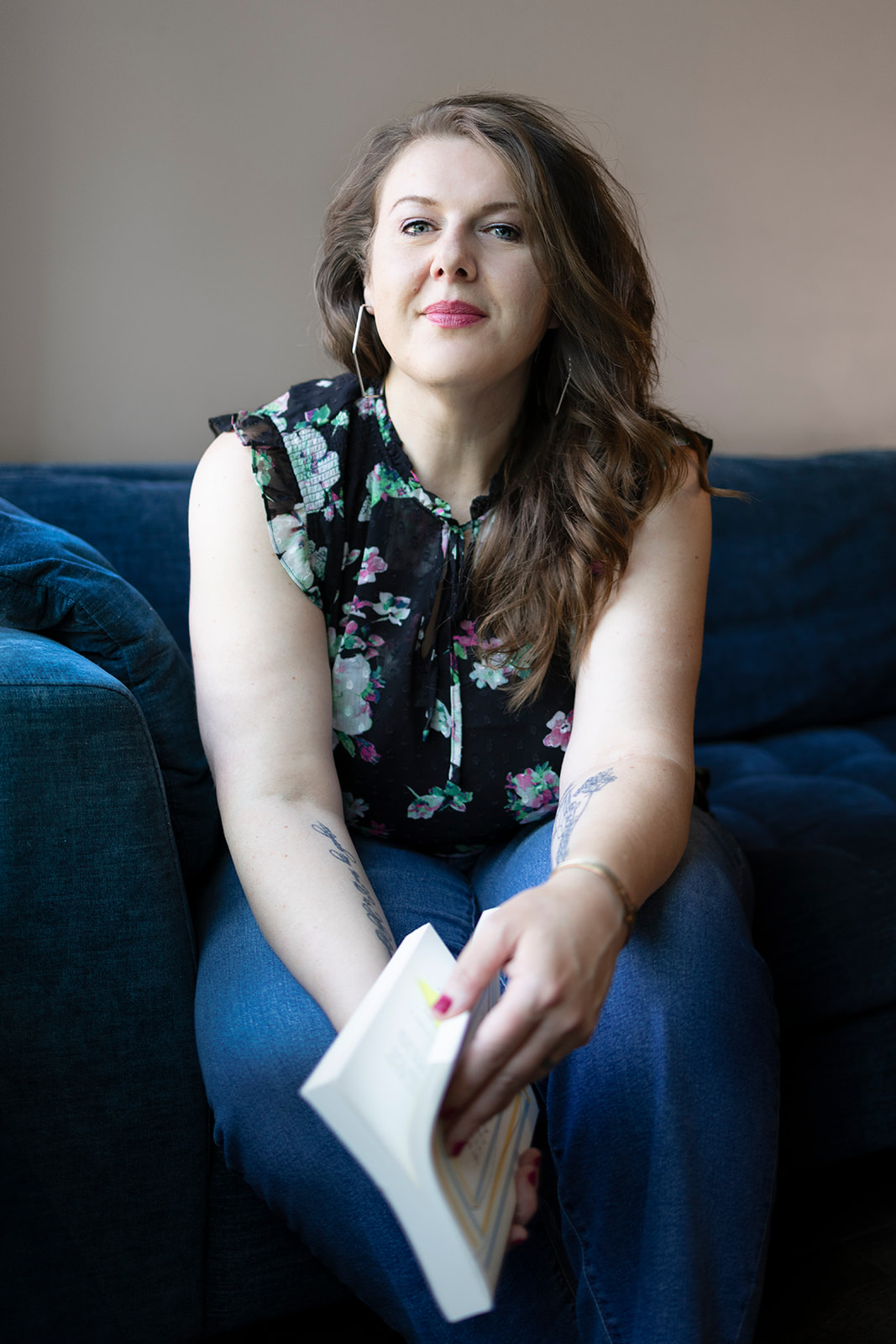
NICOLE BREIT (she/her) is an award-winning essayist, bestselling author and founder of the R/evolution Story Lab, a creative community and online learning space for memoir and creative non-fiction writers. She is the author of Bloom: Letters on Girlhood (Caitlin Press), described by readers as “hilarious, intimate, heartbreaking, authentic, evocative and tender.” She has been widely published in literary journals and anthologies, including Swelling with Pride: Queer Conception and Adoption Stories (Caitlin Press), Awfully Hilarious: Pillow Talk (Tidewater Press) and Getting to the Truth: The Craft and Practice of Creative Nonfiction (Books by Hippocampus). Her mixed time-lapse essay about the death of her first love was selected as a Notable by Leslie Jamison, editor of Best American Essays 2017. Over the past decade, Nicole has helped thousands of writers sidestep blocks, improve their craft, get published and win awards. She is at work on a multimedia memoir about a digital romance that explores the intersections of queerness, polyamory, neurodivergence, kink and attachment theory. Follow @the.nicole.breit on Instagram, where you might catch her reading in the tub or lip syncing to Lola Young.
You can also find Nicole’s work in EVENT 45/3.
OLIVIA MACDONALD: Your early creative breakthrough took the form of a lyric essay as a way to approach and process difficult memories. Has your relationship to grief and vulnerability in writing evolved since then?
NICOLE BREIT: It’s been 10 years since I wrote “An Atmospheric Pressure,” and I remain a huge fan of the lyric essay. I think of the lyric as an invitation to invent and innovate as well as approach difficult material. It took me 25 years to write “An Atmospheric Pressure,” which was about the sudden death of my first love. I had tried to write that story many ways, but the lyric offered me a chance to explore memories and piece them together in small vignettes like a collage. Because the lyric doesn’t require that a story be told chronologically and allows for gaps, it freed me to work with the memories I had and work them into a powerful pattern. The piece moves backward and forward in time in a kind of grief loop, beginning with me leaving the funeral home, then alternating timelines. I think the lyric offers writers a chance to convey what memory and our emotional experience is really like with trauma—certainly not linear.
I do think my relationship to writing about grief and vulnerability has changed over the years. I’ve been writing, publishing and teaching creative non-fiction for a decade now and began because I was looking for a way to heal. Now, when I reflect on the impact of writing intimately about vulnerable material, the word that comes to mind is “transformative.” Writing about trauma, grief and loss changed me. It allowed me to change my relationship to the past and see myself with more compassion. The healing will naturally come when we write expressively, but now I see what a powerful tool writing CNF is. Writing gives me a feeling of personal power and authority over my life when I often feel powerless at the time of an event I’m writing about. Many writers I’ve taught who have a lot of trauma to work through call writing CNF liberating, even life changing. We embody a deep sense of power when we have the courage to say, “This happened to me, and here was the impact.” To stand up for yourself on the page and speak your truth really does set you free.
OM: When it comes to writing about difficult topics, how do you assess when a memory or experience is ready to be turned into memoir? Are there signals in your process that tell you a story can be written or should be put aside for a while?
NB: I like the word “signal” and think the answer to this question is paying attention to an urge to write. I think that’s always how it starts for me, this feeling of building pressure around an experience that I need to process. Often, my bigger project ideas arrive in what I’ve heard described as a “download.” When that happens, I just write down what is taking shape as an idea and let it simmer a bit. I’ve heard writers like Liz Gilbert, Dinty Moore, Sarah Selecky and Betsy Warland talk about stories having their own consciousness or intelligence. I trust my stories to tell me when they’re ready to be written, and I am there to catch them.
I usually set something aside if I feel I’ve used the energy needed for a piece to achieve its goal. Sometimes that’s simply expressing a thought or feeling. Not everything I write is meant to be shaped into a publishable piece and submitted. I lose energy when a piece has achieved its purpose. But in other cases, where my goal is publication, I will at times reach a point where I’m just not sure how to continue. I hit an edge or a wall, a seeming dead end. With my current project, The Queer Poly Kinky Anxiously Attached Neurodivergent’s Guide to Surviving a Long Distance Online Relationship, I’ve had to set it aside for months. It began as a collection of essays, and it’s telling me it wants to take a different shape, so it’s on hold right now while I figure out how to take the next step.
OM: You’ve described the importance of building your literary CV through contests and journals early in your career. Do you have any advice or encouragement for writers who are just starting to send out their work?
NB: Don’t overlook anthologies as a great opportunity to get that first acceptance. I recommend researching calls for submission on subjects you want to write about, and don’t limit your search to North American markets. My first published essay was with a small Australian press putting out a collection of stories about pregnancy loss. Knowing I had an opportunity to be published in a book gave me the motivation I needed to get it done and send it out. I’m so glad I did! That first publication boosted my confidence that I had something to share and that there were people out there who might want to read my work. I also encourage writers to submit before you feel ready. It’s part of the writing life, and it gets easier with time. Do it systematically with a tracking system. And always have a plan B for a piece so if it isn’t accepted you don’t have to think about what to do next. You’ll feel better just sending it along to its next potential home.
OM: How do you balance external recognition with internal measures of progress or fulfillment in your writing practice now? Has that changed over time?
NB: This has definitely changed over time. External recognition used to be much more important to me when I began to take my writing seriously. I wanted the validation that I was a real writer and not just someone with an obsessive hobby. I wanted to build a career as an author and that wasn’t going to happen if I didn’t figure out how to get published. Although I still want to be read, I’m much more interested in how my work is evolving creatively now. How far can I push it into new territory? The current project I mentioned feels like it’s expanding beyond the constraints of a book. It might evolve into a series I publish on a Substack so I can really experiment with dropping in selfies, changing fonts and text colours, which is how I’m envisioning it. It brings me a lot of pleasure to stretch, to create and express myself while exploring new edges of what creative non-fiction can be.
I find writing fulfilling in that I recognize the extent to which it is much more for me than art-making, which is a worthy pursuit in itself. It’s a tool for living. Writing is how I process my experiences and make sense of daily life. I recently reflected on how much unfinished business I was able to resolve in my writing extending far back into the past. These days, I find myself writing about what’s happening in real time. I wonder if other writers who’ve written extensively about childhood trauma notice that, too. I’ve let go of the idea that my stories only matter if someone wants to publish or read them. I find it very fulfilling to have shaped an idea into a story, to look at what I’ve written and feel satisfied that I created something new. I often discover something I hadn’t realized before when I’ve written a story and that makes it very meaningful, too.
OM: You write about using an approach you compare to scientific experimentation. How does this approach differ from a traditional writing process? What breakthroughs has this brought you in your personal writing journey?
NB: I think my approach upends how we’ve been taught to write. I work in small fragments and assemble them into a whole rather than attempt to start at the beginning—wherever that is, I never know!—and move through a chronological narrative. Experimentation means pursuing a question with curiosity, like a scientist, rather than reporting events to tell a story, which I find boring to write and to read. Reportage lacks energy because there’s no sense of risk, no question to pursue, no discovery.
I think two parts of my brain work together when breakthroughs happen. There’s the part of my brain asking the question—the scientist—and the other part that is highly creative and wants to find the answer. One example of a breakthrough was with my current project. One aspect of The Queer Poly Kinky Anxiously Attached Neurodivergent’s Guide to Surviving a Long Distance Online Relationship is attempting to convey what it’s like to live inside a neurodivergent brain as a 50-year-old woman who was late-diagnosed with ADHD.
A breakthrough occurred when I let the scientist experiment with formatting dialogue in my piece in different colours, then fonts, to distinguish the narrator and her partner when in conversation. Then the creative problem solver thought, “Oh! This is fun… the narrator has a lot of voices talking in her head. What if they also had their own text font and colour to indicate when a thought is emerging from her 16-year-old unhealed self?” I chose a gothic font for the young and tragic romantic that sometimes emerged as I wrote. I had to create a key so I could keep track of those recurring voices and write them into future essays, then revise older ones I’d drafted before the breakthrough!
OM: Are there any other unexpected places or practices that have been a source of inspiration for you in your writing? Do you find that your work in other mediums—visual art, poetry—influences the way you perceive or structure creative non-fiction?
NB: I’ve always been drawn to visual art and in my younger days did a lot of painting. The early stage of my writing process often includes doodles, mind maps, drawings and tables as a way to brain dump ideas, make connections and organize my thoughts before I write. My love of visual art also influences the shape of my creative non-fiction. I’m especially fond of the triptych essay, inspired by medieval three-part devotional paintings. My current project began as a series of linked essays in the form of how-to articles, but now I’m considering how to use technology to bring the piece to life. It’s about a digital romance and I think it may ultimately find its form via a web-based app. In addition to wanting the flexibility to change text fonts and colours, I want to include selfies and other graphic elements. In this case, I’m exploring how communication technology like messaging platforms and dating apps can re-create an experience through storying.
OM: What criteria or instincts guide you in choosing a structure that best serves a particular story? Do some themes inherently invite certain structures?
NB: I can’t say that some themes invite certain structures, but I think the reverse is true—that some forms are inherently potent containers to tell a story. I’m thinking about a hermit crab essay by Rowan McCandless called “Binding Resolutions,” which uses the format of a legal contract between two parties—the narrator and her abusive domestic partner to tell the story of her oppression. As for my own process, I like to begin with a mind map when I feel inspired and then create some structure to begin a draft, just to get started. If I decide up front to write a piece in three or four or five sections or just 100 words, I’ll narrow my focus with all the possibilities of what a piece could be, which helps me avoid feeling overwhelmed before I begin. As a piece progresses, I may get stuck or get a new idea for how to shape it, and that might mean abandoning the first structure and trying something different. I get a little tingly feeling when I realize a piece has found its form and at that point, it feels like puzzle pieces falling into place. Such relief!
OM: Can you give a brief overview of your new writing community, the R/evolution Story Lab? At what stage in the writing process would a writer most benefit from joining your collective? What kind of writing challenges or project stages indicate that someone might benefit most from becoming a member?
NB: Absolutely! The R/evolution Story Lab fills a gap in the writing community for creative non-fiction and memoir writers. It’s a living, co-created learning, writing and growth hub that offers writers a warm, welcoming, inclusive space to create together. I wanted to encourage and support creative non-fiction writers who may be exploring difficult material and unprocessed trauma. That’s why R/SL is facilitated by a trauma-informed community manager who holds the space for us. Together, she and I host live sessions for our members —workshops, write-ins, silent writing, guest speakers, coaching calls and weekly writing challenges. Writers also move through my 12-month program together to deepen their craft, experiment with new forms and learn how to revise, polish and submit their work.
I think one of the main challenges R/SL can help writers with is the sense of isolation so many of us feel. It is so much easier for me to write when I’m working alongside a supportive and encouraging group. But it can be particularly difficult for writers to find folks who understand what creative non-fiction is, let alone what’s required to write it. Inside the writing community, you’ll find CNF workshops and courses, but when they end, so do the connections and conversations and the sense of belonging. Further to your question about writing challenges or project stages, R/SL was intentionally designed to support writers at every stage of their evolving journey, whether they’re brand new to CNF, at work on a long-form project, or just want a safe place to dig deep into the impact of their lived experience through personal narrative. We have poets and playwrights and novelists in our community too! All kinds of creative work feeds into our discussions about CNF.
OM: What advice would you give to a writer wanting to experiment with memoir and creative non-fiction? Do you have any tips or exercises for writers to challenge themselves to get outside of their comfort zone in form and content?
NB: I’d invite writers who are new to creative non-fiction to read widely to get a sense of what other writers are doing that resonate in theme and story shape. I really believe in imposing constraints as a creative challenge to get started drafting a new piece. A fun way to do that is to take a piece you love and use it as a template for your first draft. It’s not cheating to let another writer’s story and structure inspire you! If you feel your piece owes a debt to another writer you can acknowledge them when your piece is published with the elegant “After Rowan McCandless,” for instance, if you wrote CNF in the form of a binding resolution document.
My other tip would be to just be present, open, and receptive as you move about your day. Pay attention to what’s around you that might make an interesting format for a piece. There really are no limits. If something exists in the form of text, it can be made into an interesting CNF piece. One of my coaching clients, Carole, created an incredible graphic hermit-crab essay in the form of a vintage album designed in Canva. She called her record “Bittersweet Ascension,” and the back of her album cover lists song titles, her bio as a singer/songwriter, the inspiration for the music. Even the name of the record label was a clever hint at the story embedded in the piece. Carole Vasta Folley’s is one of the most brilliant CNF pieces I’ve ever taught. She had never heard of creative non-fiction when she signed up for a class with me, and just a few years later, her work is getting published and winning awards. It’s amazing how quickly a writer’s career can advance when they experiment and write what’s in their hearts.
OM: Are there any memoirs, essays or craft texts that shifted your understanding of what creative non-fiction can be? Are there any works that you adore, that inspired you, got you into writing or have shaped your practice recently?
NB: I’m a big fan of Sarah Minor’s work, particularly her collection called Bright Archive, which includes such genre-bending visual essays and short prose pieces. It was described as “architectural” by Aisha Sabatini Sloan—and that’s a great description. Text is formatted upside down in the first essay; in another, the text is contained within angled lines drawn to create the impression of the structure of a house. Her quilt essay, “Log Cabin Square,” is printed as a separate insert that you have to unfold to read. Her work showed me how to break the essay and open it up into something more expansive that relies heavily on graphic elements, which I love. I’m also a big fan of everything Melissa Febos has written, including her craft book Body Work, which I’m re-reading at the moment. I highly recommend this book for writers of memoir because it honours the deep importance of writing intimately and honestly about our lives, which can be so often minimized or dismissed in our culture. It’s a book about power—the power we possess when we write our truths and the powerful impact of writing to heal and connect with our readers and communities.
OLIVIA MACDONALD is the Magazine Intern at EVENT. She is currently completing a Master of Publishing at Simon Fraser University and is co-editor-in-chief of Bitter Magazine.