
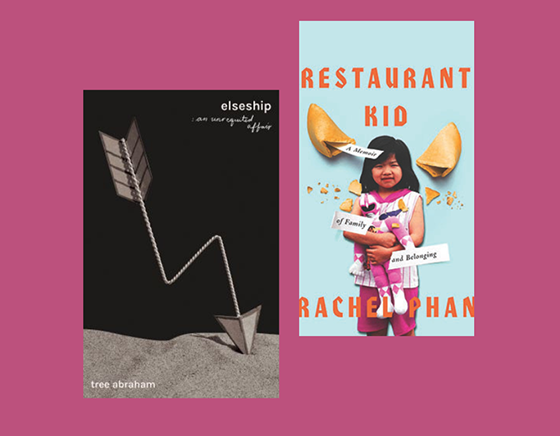
Rosalie Morris Reviews:
Tree Abraham, elseship: an unrequited affair, Book*hug Press, 2025
Rachel Phan, Restaurant Kid: A Memoir of Family and Belonging, Douglas & McIntyre, 2025
While many memoirs focus on extraordinary stories that sweep you away into a world unlike your own, often the most satisfying memoirs are those that demonstrate the complexity of the mundane parts of life. Beautifully illustrating how a seemingly commonplace story can be the most meaningful, Tree Abraham’s elseship and Rachel Phan’s Restaurant Kid dive deep into relationships that appear simple from the outside: a pair of housemates sharing an apartment in New York City and a working-class immigrant family running a restaurant in an unremarkable town.
‘Commonplace’ is an appropriate word to introduce elseship, since it is not so much a memoir as a commonplace book. Abraham’s prose is intermingled with illustrations, lists, diagrams and ephemera that make the book feel more personal and intimate than just text on a page could. Abraham meticulously documents her unrequited love for her housemate, whose name is blacked out every time it is mentioned, both preserving anonymity and nodding to the elusiveness of the relationship. While most stories of unrequited love end with either the dissolution or progression of the relationship, elseship shows, as the title implies, something else. Instead of becoming romantic partners or ex-friends, Abraham and her housemate navigate the ‘undefined elseship’ as it is. There is no finality or resolution, just two people with different types of love for one another navigating how that love can manifest and coexist. Abraham highlights how her story differs from the typical romantic story, writing, ‘I know which love stories get written about, and they are not mine—a story about a first love that is not heterosexual or sexual, and at times not even reciprocal.’ Abraham’s love is not only unrequited and queer, but it also doesn’t fit into a normative sexual script, being ‘more celestial than erotic.’ As such, Abraham’s love story feels relatable due to the familiar notes of yearning, affection and ecstatic bliss, but it plays out much differently than the relationships commonly depicted in popular culture.
Abraham’s writing is refreshingly straightforward and pragmatic. One description of what love feels like is particularly disarming. Abraham writes that love ‘feels like birds trying to flap their wings inside me, but they can’t get out so instead I almost fly—filled simultaneously with a sense of levitation and confinement.’ This is a version of the ‘butterflies in your stomach’ aspect of love that everyone has heard of, but Abraham beautifully and simply articulates that feeling’s contradictory experience of being buoyed up and simultaneously restricted. Abraham’s use of birds flapping their wings harkens back to an earlier anecdote that details how a childhood visit to Piazza San Marco in Venice forever impacted her. ‘Standing in the piazza as pigeons flapped up and around me, that was it,’ she writes, adding, ‘The crushing sense I suddenly had and took back with me was how much possible love lived beyond my small suburban life. Knowing it was out there but wasn’t mine to inhabit felt like an injustice.’
elseship’s multimedia elements bring a delightful injection of whimsy and playfulness into the pages. One such element is the two-page handwritten catalogue, complete with images, of all the little things Abraham wants to remember about the relationship with her housemate, including items such as ‘your indoor clogs that never come off and sometimes turn into outside clogs’ and ‘the rubber pelican found while searching for four-leaf-clovers.’ Abraham is at her most charming when she’s working out complex feelings through cataloging, diagramming and listing.
Rachel Phan’s Restaurant Kid is another memoir that homes in on the space between people and what navigating that space looks like. Phan documents her experience growing up as the child of hard-working immigrant parents whose time is mostly spent keeping their Chinese restaurant running. Phan is one of the only Asian kids in her Ontario town in the nineties, and Restaurant Kid documents her trajectory from being a young girl proud of her Chinese heritage to an adolescent who resents her racial identity because of how her classmates and the culture at large treat her. As an adult, she comes full circle, desiring to connect more deeply with her culture and, simultaneously, the parents she felt neglected by as a kid.
Fittingly for a restaurant kid, Phan tracks her relationship to her cultural identity through food. As a child, the food she loves most are ‘chunks of moist chicken smothered in a fragrant yellow curry sauce and no vegetables in sight.’ This indulgence is reserved for an after-school snack only. For lunch at school, Phan begs her mother to pack ‘ lukewarm Chef Boyardee or…sad Lunchables.’ Phan doesn’t enjoy these foods, but they give her the ability to blend in more closely with the other kids at her predominantly white school. She writes, ‘when Mum tries to send me to school with…food I love and crave, I always resist. “No one likes this food at school…. No one will like me if I eat it.”’
As Phan chronicles her childhood and adolescence, we see her make herself smaller over and over again to fit in, to be invisible to her peers. It doesn’t work. Throughout her teen years and 20s, she is still victimized by racialized violence in various forms, most notably sexual fetishization that leads to one disappointing hookup after another, eventually culminating in a long-term relationship with a white man whose own racial hang ups (and disgust at her parents’ traditional Chinese and Vietnamese cooking) contribute to erasing Phan’s identity as a Chinese-Canadian woman. Eventually, after Phan begins to embrace her identity and reject the racist and dehumanizing script foisted upon her by white culture, she is able to finally enter into a healthy relationship with a man who is delighted to serve ‘dim sum, barbecued duck, soy sauce chicken, and bánh xèo’ at their wedding because he ‘wants his family and friends to experience the flavours [she] love[s] most.’
Phan’s story is about an average kid growing up in an average family; nonetheless, it’s quite poignant, demonstrating the complexities of identity and belonging. However, Phan goes further by delving into her own parents’ astonishing stories. Her parents’ lives were marked by extreme poverty, trauma and survival against the odds. Their stories are not remarkable for Asian immigrants of the time but are representative of what a generation of people survived in the wake of the Vietnam War. In her telling, Phan does her parents’ stories justice, but she even more skillfully explores how her parents’ lives informed their relationships with their children. By getting back in touch with their roots, her parents deepen their connection with their children, who are now grown adults capable of seeing their parents as full people, shaped by their histories.
Restaurant Kid is an illuminating chronicle of identity, self-acceptance and familial bonding. Phan devotes generous space to each of the main figures in the book, approaching her material with care and com-passion and powerfully demonstrating that her story is inextricable from her family’s. In this way, she avoids falling into the trap of solipsism that hampers so many memoirs; hers is a nuanced work that tells a personal story while reaching beyond the self.
Both Restaurant Kid and elseship are intriguing memoirs that document the way relationships form, evolve and change. Neither Phan nor Abraham settles for neat and tidy relationships that fit a prescribed cultural script. Instead, they celebrate the messy grey areas and the deep wells of joy and insight to be found there.
— Rosalie Morris