
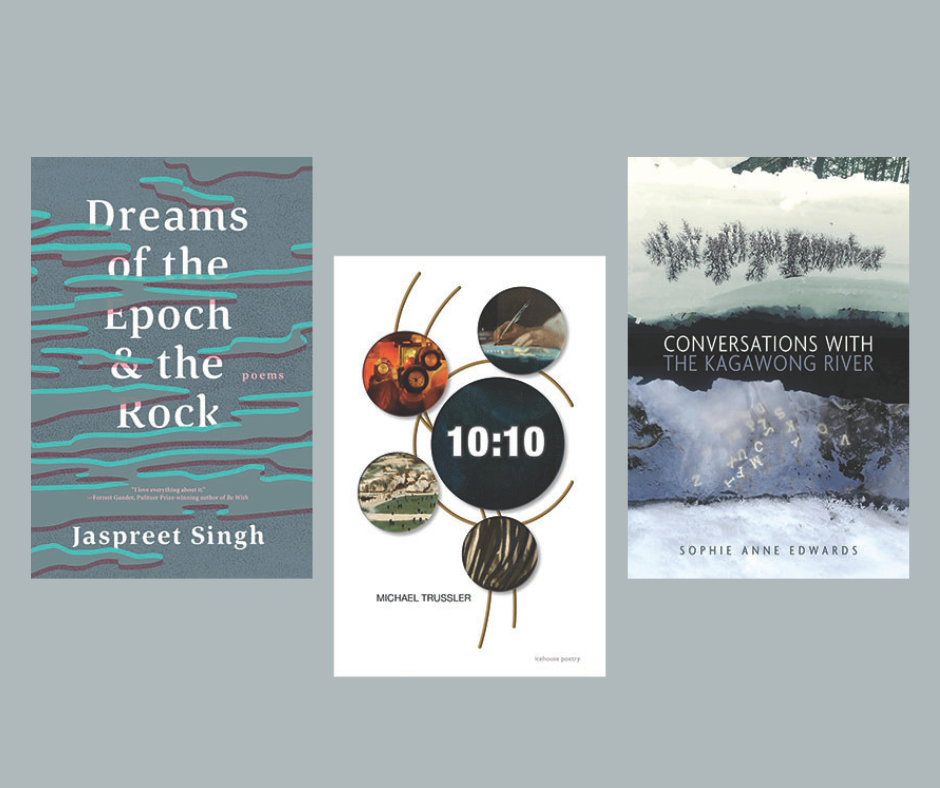
Kathryn MacDonald Reviews:
Jaspreet Singh, Dreams of the Epoch & the Rock, NeWest Press, 2024
Michael Trussler, 10:10, icehouse poetry (Goose Lane Editions), 2024
sophie anne edwards, Conversations with the Kagawong River, Talonbooks, 2024
Some poetry books make me think; others bring joy. Dreams of the Epoch & the Rock by Jaspreet Singh does both. As in his previous writing, this collection is firmly situated in the Anthropocene, featuring poems about the Earth’s climate and ecosystems in our time. Yes, science plays a big role in this collection, and so does beauty and deep encircling empathy. In ‘The Apple Inside the Brain,’ the speaker is told to imagine an apple:
The apple I saw was the one
that began my childhood at Nishat in Kashmir Grandma
in a pherozi stream was already washing it
Her unironed face
smiling on behalf of the earth
I described the bit of the crunch
the taste the honey smell
I had to look up pherozi, a blue-green or turquoise colour, but even with-out knowing, I wasn’t stopped because the words suggest water flowing. Both words and lineation carry me forward—a hallmark of the collection. I love the specificity of place, of Grandma’s ‘unironed face/smiling on behalf of the earth,’ the ‘crunch,’ ‘the taste the honey smell.’ Singh stirs our empathy, linking apple-childhood-Grandma-Earth. He gives us image-colour-sound-taste-smell. He gives us hope despite the destruction of our ecosystem. He leaves us with the apple’s ‘ripening.’
Another favourite poem that lingers is an ekphrastic in which the speaker sees a painting: ‘Not [Egon Schiele’s] self-portraits, not the artist’s reclining figures,’ but ‘a little tree’:
Hours later
on the train to Vienna the tree
accompanied me as a choric voice. In the hotel room
leaves sprouted from my arms fingers ears
I knew this was going to happen. I let it happen
Despite their beauty, the poems in Dreams of the Epoch & the Rock do not lull. They startle and they question. They open my eyes to the Anthropocene, this era we are entering. Some send shivers along my spine. Like me, you may find ‘Everyone is an Oracle Now’ and the long titular poem ominous. In ‘Thirteen Frames: The Age of the “Human,’’ ’Singh warns: ‘A storm is brewing/inside all of us big/as the one outside,’ a thought that takes me back to the brain scan and the apple.
The ekphrastic poems, in which he explores and enlarges the work of other artists, resonate deeply. ‘Burtynsky’s Photograph of Deep Time’ invites us into the photograph of a sunbathing couple, placidly sitting with their backs to an enormous rock, ‘ birthed in the deep ocean.’ I have already mentioned ‘Kunsthaus’ and Egon Schiele’s tree. In ‘Thirteen Frames: The Age of the “Human,”’ the speaker admires Rembrandt’s painting A Woman Bathing in a Stream for the way the water is conjured by the oil paint; later, the poem returns to the image of a woman in water, this time in order to describe water poisoned by methane. Singh isn’t afraid to point fingers, writing:
In old films they wore
fat tuxedoes
their mouths always
sucking
big smoke-
eaten cigars
Now the filthy
rich men
shown as astronauts
in NASA-suits flying to Mars
This poet knows his subject and his craft. With simple, direct language he takes us into the complex situations—moral, environmental, existential—in which we find ourselves.
Michael Trussler’s 10:10 is a deeply layered collection of thematic poems that surprises and satisfies as he reckons with history—his and the one we share. 10:10 is a lyric work, burdened by an overriding sense of loss. Trussler tells us that ‘Solastalgia is grieving a lost landscape.’ His lost landscape is the landscape of youth, camping and travel, museums and galleries, a starting place for many of the poems. This personal landscape intertwines with the life of Etty Hillesum, a diarist during Nazi-controlled Holland who was murdered at Auschwitz.
In ‘Solastalgia,’ Trussler takes us on an ever-enlarging journey from environmental degradation to his 17-year-old self who sees Monet’s Impression, Sunrise in a gallery in Denver to ‘this year’s forest fire season in western Canada.’ He moves from lyric to prose, from his youth to the destruction that began during World War II:
This destruction, the so-called Great Acceleration, taking off after World War II, was implicitly present while we innocently traveled with…a retired geography teacher, who fought in the British army during this war [and] had been one of the troops that liberated Bergen-Belsen.
This happens over and over in the poems. The narrative weaves toward the ever-present Holocaust: ghostly, buried shallow (if buried at all), not silent, always rising to the surface. A haunting in the present.
The poems become conversations between the lyrical beginning and the prose ending, as it is in ‘The Mountains’:
The Mountains
are hallucinating again, this time
a bright cluster of pumpkins in the snow.
The river’s litter of stones
are long past midnight—
as someone lays out breakfast dishes only
a few hours from the day’s delivery
of flowers freshly cut in Kenya.
Tomorrow’s roses are
flying now, a fence length of children
flying
toward (unstriped) white linen in Berlin.
From this beginning, the lyric turns to prose-poem, a discussion or explanation:
It’s not that most things are hard to describe that’s disturbing—watching the stones beneath the Bow River after the first snow, or hearing a waiter lay out plates and cutlery, keeping to himself, doing a task that must’ve been performed by so many others each night for decades in this Berlin hotel—what’s worrisome is something else….
Trussler is a lyric poet, and in ‘Streetcar Out, Owl’s Claw In: Some Notes on Lyric Poetry,’ he provides the best review of his book. This poetic essay alone is worth the price of the book for its clarity and the insight it provides:
Lyric poets try to articulate the blind universe that passes through everyone.
Obsessed with transience, lyric poems unwrap immediacy with un-discovered combinations of words. They rebel against time and the daily blur of what happens.…
Put differently, lyric poetry enacts the war between what’s visible and the amplitude of what’s missing.
Trussler unveils not only lyric poetry but also his process. He urges us to hover ‘just beyond or beneath the page [in] an homage to the exact defiance that caused people to riot in Budapest in 1956.’
10:10 is not an easy read, but it’s worth the effort. The author’s notes help answer many questions that a first read raises. It wasn’t until I had read from start to finish, left the book for a bit, and returned to reread that I began to appreciate the depth and breadth there is to discover.
In Conversations with the Kagawong River, sophie anne edwards offers readers a glimpse into the treaties that shape Manitoulin Island, located on the territory of the Anishinaabeg in northeastern Ontario, as it is to-day. As a settler seeking oneness with the river (known in Anishinaabemowin as ‘Gaagigewang Ziibi’), she ‘grapples with loving an occupied landscape’ and ponders ‘ the necessity for a wholly other set of relations.’ To guide her, she turns to Indigenous knowledge and language, ‘inclusions,’ she hopes, that ‘act not as a claim, but as an incantation, a call to the River.’
Conversations crosses disciplines and genres. It includes poetry, prose, historical documents, sketches, photography and cut-out alphabet letters dropped into the landscape. Readers are treated to the words of today’s Indigenous Elders and storytellers, to flora and fauna across seasons and to the ever-changing rhythms of the Kagawong River itself. The overarching approach is one grounded in openness and curiosity. For example, in ‘Conversations with my Toes Dipping…’ edwards writes:
I want to sit with the River
try to hear what she might say
about herself
if she might teach me to listen
and to listen differently.
To better listen, edwards adopts the use of a ‘field book’ in which to note her observations. ‘ I begin by walking along the River,’ she writes. ‘I am attracted to the embodied and the sensory, but I know I cannot know the River without also understanding how she’s become what she’s become, and how she continues becoming.’
Telling the river’s story can be challenging. edwards writes, ‘I have been confronting my lack of words; this inarticulation born of grief—environmental grief, coupled with my limited capacity to interpret and name the biotic world.’ Can language ever capture the multiplicity of the river? edwards provides an answer by providing a long list of Anishinaabemowin words relating to the river, titling it ‘The River is in the Lan-guage, the Language is in the River.’
As for her own ability to describe and name, edwards gestures to a ‘third space that is neither me and my English’ nor the natural world: ‘A middle place of translation, relation, and unknowing.’ Liminality is rich territory for edwards. She writes, ‘I found I didn’t have the language to write about/or with or from the River/and so I found myself instead/ trying to work from the space/between me and the River.’ In doing so, she explores the in-between spaces of seasons, cultural knowledge and language. ‘I still do not speak River, or otter,’ she writes in ‘October, Two Years Later,’ ‘yet my body hears differently now.’
Conversations with the Kagawong River is a collage of genres and disciplines, a field study that occasionally reads like an academic thesis. The book is classified as poetry, which it contains, but Conversations is not poetry alone, nor is it only about the river. It is also a book about Indigenous language and alphabet, place, ecosystems and cultural and social change.
— Kathryn MacDonald