

Sending and Receiving Letters: An Interview With Nadia Ragbar

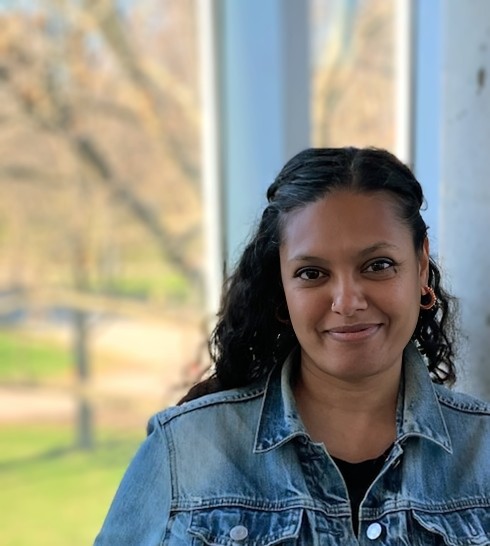
Nadia Ragbar lives in Toronto with her partner and son. She has previously published her flash fiction work in This Magazine, as well as Broken Pencil. The Pugilist and the Sailor is her debut novel.
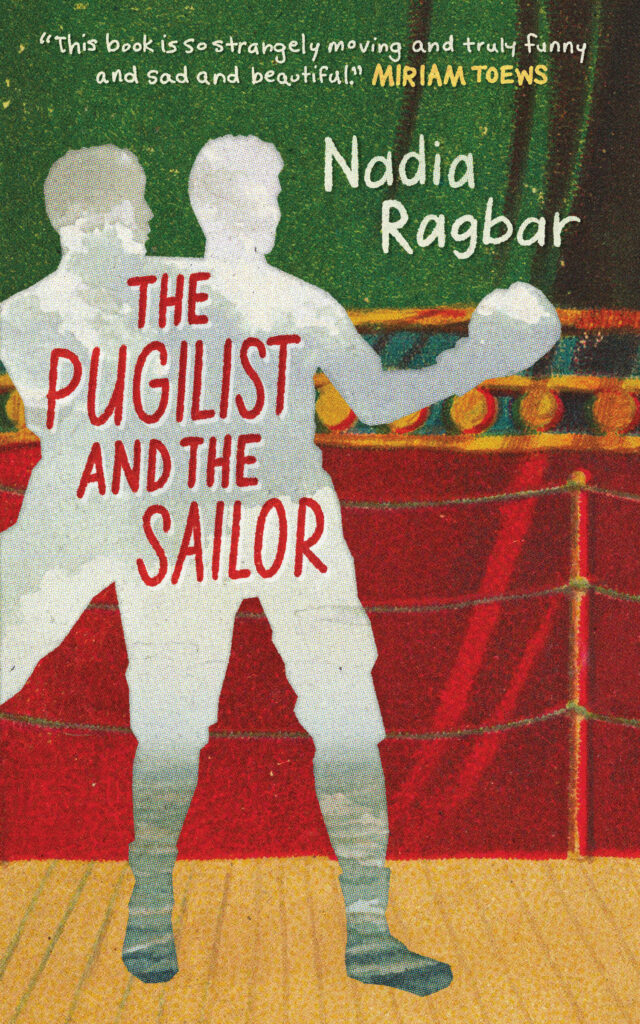
Melissa McDonald:The Pugilist and the Sailor is a story about conjoined twins Bruce and Dougie, told across various points of views and time periods. I love the idea of the non-typical protagonists you’ve chosen. What made you want to write a story about conjoined twins, and how did you begin to develop their individual personalities?
Nadia Ragbar: A long time ago a friend lent me the incredible Geek Love by Katherine Dunn and it really stayed with me—it’s a story about a carnival family whose members include a pair of conjoined twins—so that became one seed that I planted. I knew I wanted to write about a character stranded in limbo, who has to make a decision in order move forward. It felt natural that in making my protagonists conjoined twins, it would raise the stakes of what it means to try to balance creating an individual life of your own making, while considering the needs of the people and the community around you. But I immediately knew that I didn’t want my characters to fall into that soap opera trope of good twin vs. evil twin, and their distinct personalities emerged as soon as I made them boxers. I knew that as a boxer Dougie was a showman; that he’d be charming and confident and driven. And I knew if Bruce was tormented and feeling stuck that his focus would be tuned inward, and he’d be sensitive and reserved and anxious.
MM: Would you mind talking a little about the research that was involved?
NR: Never having boxed or sailed, myself, my research was primarily through reading or watching movies and videos. I read about Chang and Eng Bunker, the first to be coined “Siamese twins,” and researched online about different operations to separate conjoined twins as infants. I watched YouTube videos of conjoined twins, of amateur boxing matches, and of ocean sailing. The inspiration for M’s character came from the real-life Bernard Moitessier, who I learned about in the documentary Deep Water, directed by Jerry Rothwell and Louise Osmond (which actually chronicles the very tragic story of a different man who had never sailed before he entered a race to sail around the world). I had to research the different activities that my protagonists are all busy with, but the emotional terrain at the heart of the writing was very familiar.
MM: I am curious about the characters surrounding the twins. What made you want to explore the relationship between Anka and Bruce through the use of letters?
NR: Thank you for asking about the letters! I love to send and receive letters in the mail—I think it’s such a lovely, gentle, thoughtful act. When I was a teenager, I didn’t actually realize that I loved to write until I was exchanging letters with someone—I had always loved to read, but until that point writing was purely utilitarian, for homework. But through the play of the letters, it finally hit me that I really needed the emotional expression and the craft of writing. For Anka and Bruce, I wanted their relationship to build, simultaneously, on the restraint and intimacy that a handwritten letter could offer. Especially now when we do so little writing by hand—a person’s handwriting is as singular as their fingerprints. When we have mementos with a loved one’s handwriting on it, their penmanship becomes like a container for their whole personality and voice. Obviously, in the book we are left to imagine what these letters would look and feel like. But I also really liked that these letters could equally become a medium to hide behind. Bruce reaches out to Anka, mentioning that he’s a twin, but conveniently leaving out the conjoined bit.
When I was in the editing process, my editor rightly pointed out that for a young woman to receive a personalized letter, at her home, from a stranger is really quite creepy. And that was not my (or Bruce’s) intention! So, I had to build up the tone around this thin line of how and why he might be able to deliver a letter, and how and why Anka would entertain writing back to someone she doesn’t know. I really hope I got it right and that Bruce’s first letter doesn’t creep anyone out! I am 100% not here as an apologist for stalkers.
MM: I imagine trying to balance wanting to stage this meet cute while also trying to not make it creepy must have been quite the challenge!
On the topic of Anka, her story is interesting in how it ties to the non-linear story, such as when we see her before her parents passed away. Your book moves through different timelines and gives us the points-of-view of characters beyond the two protagonists. Why did you decide to tell the story non-linearly, especially going back in time to the twins’ mother’s childhood?
NR: As I was exploring that balance between the Individual and the Community, I found that I couldn’t tell Bruce’s story in isolation. I had to go back to why his parents, particularly his mother Jane, chose not to pursue an operation to separate the twins when they were born. And as I was writing Jane’s sections, I understood that to understand her decision I had to see what her relationship with her own parents was like. Essentially, Jane’s mother had abandoned her family, which shapes how Jane wants to raise her children, and so Bruce’s inner conflict in trying to fight for his voice to be heard, and to create a life of his own making, doesn’t happen without his grandmother’s decisions. I don’t expand on his grandmother’s perspective, but in my mind, she was struggling with a similar issue.
From the outset, I had wanted the form of the story to mirror its content by conjoining different points of view in an ensemble cast and jumping back and forth in time to create a kind of patchwork effect. And similarly, I hoped that, throughout, as Bruce is reading about M, that book-within-a-book, and even the letters that pass back and forth, could become a kind of conjoining of different textual strands being knit together.
In this way, Bruce himself exists as a book-within-a-book: his story doesn’t exist without the decisions that came before (as is true for all of us). Bruce is looking to M, the sailor, as a kind of mentor for how to forge a purely autonomous life, but ultimately, I think we become our best selves in relationship to others, in community.
MM: You have previously written short stories and flash fiction. How did writing those compare to writing a full-length novel? Do you find your style of writing tends to lean toward longer or shorter fiction?
NR: I’m definitely leaning toward longer fiction. I think my flash fiction and short stories were all character driven, and so I am enjoying digging into that in a more expansive way. Right now, I really enjoy writing a sprawling cast of characters; I like considering the specificity of every major or minor character who walks onto the page! I like the idea that meaning in a novel might be cobbled together when you consider different facets of a situation, from all sides. Writing longer form is also helping me learn about plot. A lot of things seem to happen in my novel, but I honestly think it’s only about Bruce just deciding to take a stand against being bossed around by his brother. So far, I think I’ve learned that plot is just a means for characters to have more feelings about things.
I definitely don’t think that writing short stories is merely a stepping stone to writing a novel. Short stories that exist as a perfect narrative morsel requires such a skillful and deft hand and, to be honest, I don’t think I have precision for it. Yet.
MM: Along the way Bruce and Dougie meet an elderly tailor, Kristof Verhoeven, who wants to create a suit for them. Can you talk a bit about the significance of this?
NR: Bruce and Dougie have been dressed by their mother for their whole lives; she alters garments to accommodate them, and at one point they’re rolling their eyes over a pair of pants she’s made them, where one side is denim and one side is corduroy. That choice, and the fact that she thought her adult sons would be into it, tells me so much about Jane! Clothes became emblematic in the writing: as a place for individual expression, we have these thirty-something men still, necessarily, being dressed by their mother. Jane has set the tone in her family life and is heroically determined to keep the world from defining who her sons are—she refuses the limitations and judgements of an ableist society. Her tenacity is probably the most hopeful aspect of the novel. But, realistically, the flip side of that determination might be a rigidity. She never wanted them to feel ashamed and want to separate, but Bruce chafes under this; he feels like his desires never fully make it into the equation. For me, the clothes the twins wear are representative of this overarching family dynamic. When Verhoeven measures them for the suit, he measures Dougie, including their shared leg, and then Bruce, measuring their shared leg again from his vantage point. He considers the twins on their own terms and then considers what compromises can be made. Jane also considers each of her sons as individuals, but not entirely independent of her. For me, the tailor stands as a second mentor figure, opposite to M. M is a lone wolf and Verhoeven is a caretaker, he cares for his grandsons, and for Anka, is a character who embodies community.
I was deliberate about the clothes different characters wear and are attached to: Anka always in her army jacket, the Marchesa Casati with her theatrical, costume-y clothes, though it is clear she has fallen on hard times. Clothing became a cypher, and an immediate point of entry for me into a character’s personality or situation.
MM: I never thought about how a character’s clothing can be such an important factor in their personality. That reminded me of an interview with the Toronto Star, where you brought up your love of Anne of Green Gables. I think clothing played an important role in Anne’s growth as a character as well. Would you say that your love of the novel shaped your writing, or influenced your style in any way?
NR: My reading of the Anne of Green Gables series is forever fused to the visuals of the mini-series starring Megan Follows that aired on CBC in the ‘80s. I remember it seemed as though the character of Anne really grew up on the screen, and for some reason that felt kind of epic to me as a kid, that faithfulness to a character over time. Thinking about it now, I realize that stories for children don’t often span a character’s lifetime: cartoons, sitcoms and children’s literature seem to exist in an ever-lasting present moment, and coming-of-age stories will span a few pivotal months or years. I think what I took from Anne of Green Gables was the whole scope of the character’s life—following Anne as an orphaned child into her adulthood as a writer and teacher—and the way that her writing became meaningful when she documented her life authentically. There was a flatness when she wrote in the pretentious, overly dramatic way that she thought made a person sound like a writer. I’ve never considered L. M. Montgomery or Anne of Green Gables to have overtly influenced my writing, but I can only assume that something about a character-driven story steeped in authentic emotion definitely pinged my radar back then! Until now I’d never considered these long-lasting effects.
MM: On a similar topic, you brought up Leonard Cohen in the same interview as your first “capital-L literature” exposure outside of the classroom. Did his writing influence you as well?
NR: I love the tenderness and longing Cohen conveyed in the most simple way: a four-line stanza with a basic rhyme scheme might seem easy to dismiss at first but can reveal something darker and deeper. That is aspirational to me—that my writing be easily accessible but that maybe there is something more emotionally complex folded into it.
MM: Now that this book is published, do you have a sense of what might be next?
NR: I’m thinking about another project that looks at the unconscious patterns that repeat down a family line. I’m really interested in the psychological and emotional DNA that we inherit, and how behaviours, passions, and events unintentionally keep repeating. The story will be centered around a Guyanese family living in the suburban diaspora, and again, it’s got me travelling back in time two generations back, and maybe even further into an ancestral past. I don’t necessarily want it to read as a family saga, so I’m thinking of having some fun playing around with the form and bringing some strangeness to it.
Melissa McDonald is an undergraduate student at the University of the Fraser Valley studying English and Creative Writing. She lives in Chilliwack, BC.