

Marguerite Pigeon Reviews New Poetry Collections for EVENT 54/2
Marguerite Pigeon Reviews:
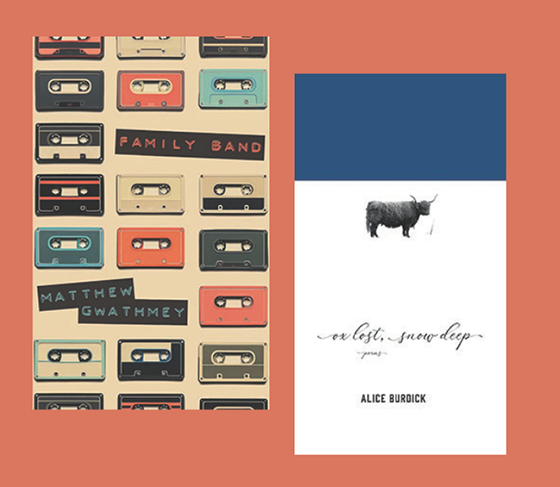
Matthew Gwathmey, Family Band, The Porcupine’s Quill, 2024
Alice Burdick, Ox Lost, Snow Deep, Anvil Press, 2024
Playfulness is an asset in poetry, as in all struggles. Play leavens weighty subjects like existence, lets poets cut loose semantically and syntactically and feels like fresh air for readers joining them in the depths of thought. One pleasure of reading poetry is to discover what specific game a poet will get up to. In his new collection, Family Band, Matthew Gwathmey develops a poetics of play.
Early in the book, Gwathmey toys with anagrams. In the poem ‘You & I,’ he divides anagrams with pipe symbols, suggesting a near mathematical urge to convey the value of relationships—here, between a ‘you’ and an ‘I.’ The poem urges readers to consider whether, in a relationship or marriage, the connection might be so strong as to come down to rearrangements of the same parts:
Hearty | earthy, a tablet | battle now | won. A large |
glare. Ours | sour. My chit | itch, your west | stew, my freak | faker,
your late | tale.
You hated | death.
I stressed | desserts.
Throughout Family Band, Gwathmey uses formal games and typographical features to get at what underpins daily life in a family and in friendship. Putting children’s snowsuits on. Family jam sessions and reunions. Factoids shared in passing. Hiking. All familiar moments, below which the poet feels something more tugging. But what? What holds experience together?
Gwathmey maintains a searching tone as he reaches for a possible formula—maybe cosmos, maybe time, love, spirit—or all of the above. Whatever the ingredients, this formula functions like his titular Band: elastic, with a capacity to hold together disparate elements of life. For Gwathmey, this connective tissue is best captured reflexively on the page, playfully and ephemerally, just as good feelings emerge spontaneously in fun moments.
For this reason, Gwathmey’s word games never depart entirely from meaning. They serve a purpose, capturing what arises in loving, coordinated action, including the act of writing. From the poem ‘Re-’:
We related our troubles. / We repaired our sinks.
We renewed our vows. / We relaxed our mores.
We removed our warts. / We reformatted our hard drives.
We reviewed our margin notes. / We referenced our inside jokes.
Gwathmey also invokes snippets of trivia from diverse knowledge sets—earth sciences, mathematics, embryology and folk medicine. Playful epistemology, then, might be a necessary ingredient in a full account of meaning. In ‘To:’ Gwathmey uses the ‘⊗’ symbol, associated with connection and the sublime, to raise a toast to gonzo science and the (possibly) gonzo choice to marry:
the still-dormant volcanoes of Japan ⊗ National Pi Day ⊗
have ⊗ hold ⊗ breathing and swallowing in unison ⊗
your health ⊗ peanut butter converted to diamonds ⊗ infinity ⊗
A Christian cosmology seems to give shape to Gwathmey’s reality. Yet, the poet also acknowledges the limits of faith when grasping at the infinite as, helplessly, we watch time slip away, fun facts lose their spark and symbols of love fade. In the poem ‘Lilacs,’ for example, plants given as wedding gifts exist in memory only, though the speaker hopes otherwise, insisting: ‘At least one of them must still be alive.’
The prospect of finality and death floats through Family Band. More than one poem deals with serious illness and injury. The poem ‘It Seemed That We Had Hardly Begun And We Were Already There’ seems to be tracking a laundry list of tasks filling daily life with young children. Throughout, it is set with thick white spaces, suggesting gaps or breath. But the poem’s final lines shatter the illusion of infinity with the sudden intrusion of a death:
then that time the bird fell from the sky a few feet from
one of them we all gathered around it the sliced neck
the dark brown feathers and all I could think to say that
kids is death get the plastic bag let’s clean it up
Family Band ends in a series of eclogues, or pastoral poems, about the American Appalachian region. But Gwathmey twists the genre, as in a tragic game, producing instead dense, fearsome poems about Anthropocene change to the landscape, especially through industrialized extraction in lumber, coal mining and grain farming. The lines, justified on the page into heavy blocks, seem to weigh down the poet with dread and regret.
For Gwathmey, poetry itself is part of the difficult game of life and the glue that can hold together experience. He engages his readers through a formal playfulness that works as well for holding close pleasure and fun as it does for assimilating loss.
Alice Burdick also likes to play. But in her new book, Ox Lost, Snow Deep, she casts a skeptical eye on the possibility of playing within constraints imposed by fixed meanings. ‘Look below and see life is quite/ independent of our need for meaning,’ she writes in ‘Great Village sequence’ early in the book. Later, she doubles down, declaring, in a general way, ‘ I object to these parameters’—presumably referring to all manner of semantic rules. Ox Lost, Snow Deep flows from this objection.
Throughout the book’s long poems, Burdick mixes images and words based on formulae all her own. What results challenges received meanings and turns sensemaking into a propulsive game of surreal exposition. The title poem, ‘ Ox lost, snow deep,’ reshapes sense around images of suspension, whether in a snowdrift, in time, in a musical note held a long time or in pants with actual suspenders. Through these images, Burdick works at troubling received meaning, a task the poem suggests is both silly fun and a serious rebuke to logics that could be fatal:
We wait for the notice. It is either yes
or no. Those are the two possibilities.
A no and a yes can be silly.
A no and a yes can be serious,
like a car arcing over a low bridge,
through ice into winter water.
Winter pulls a thread of sound,
so bubbles climb lights’ suspenders.
Burdick’s poems look serious enough on the page. Nearly all are divided into short to mid-length stanzas, with lines and enjambments forming brief sentences. Burdick relies on this conventional syntax as a sleight of hand, her games appearing seemingly out of nowhere as she, for example, twists declarative and imperative lines. From ‘Brine’: ‘I deal well with icicles, although it’s not ideal./Do not leave the young old man in the forest.’ Elsewhere, the speaker’s declarations of advice, or wisdom, reveal something closer to the poet’s view of reality, which includes a deep suspicion of representation, as in ‘Reservoir’:
The life story is a lie.
It’s okay though. It’s realistic to wonder about the truth.
It’s a variable field. We have different ideas
about what it means and intends.
Burdick places herself in a lineage of surrealist writers who see the marvelous (as André Breton called it) as indispensable to poetry. The marvelous resists universal truths, places fantasy and dream on the same footing as rational thinking and allows poetry to be productive in and of itself. As Burdick urges her readers in ‘Great Village sequence’: ‘ Nurture the least obvious,/stronger, stranger ideas.’
In Ox Lost, Snow Deep, the least obvious is the antidote to deadening lyric:
Too many write dull and straight
regardless of identity.
Give me angles.
Make it strange, like life
Burdick is skeptical, tough, punk rock, a believer in the value of the present and in the practice of poetry as an end in itself. (She even names the poem from which the excerpt above is drawn in the imperative: ‘Practise.’) Burdick has little time for the egoists, politicians, smug bourgeois and exploiters who bend truth to strengthen their grip on power. In ‘Suspenseful demographics,’ she again calls for readers to join her in taking the piss:
Let’s go to the capital and meet
the important bastard tsar. Blood
sinks through the tapestry. You
deserve an amazing house. This guy
thinks his dick is incredibly full of hope,
but that’s the salad fork talking.
In this way, Burdick tears through Ox Lost, Snow Deep with ferocious energy. Amidst fantastical images, she makes room for a sustained attack on cliché, reworking tired phrases for political effect (‘life irritates art’; ‘less/is poor’ ). She also battles snobbery (‘Artisanal local anachronistic/eye-stink.’ ) and greed (‘the polar opposite of a billionaire/is a polar bear.’ ) There’s a pugilist in this ring. Burdick is fighting for her freedom to think and feel in the absence of any greater meaning. Her poetry is like a toy gun that shoots bright flowers.
Matthew Gwathmey locates his game pieces in elastic semantics—repetition, anagram, twisted factoids and typography. Burdick locates hers in mashups of the everyday and the strange. The reader can turn to both poets for serious fun.
— Marguerite Pigeon