
Carmen Faye Mathes Reviews:
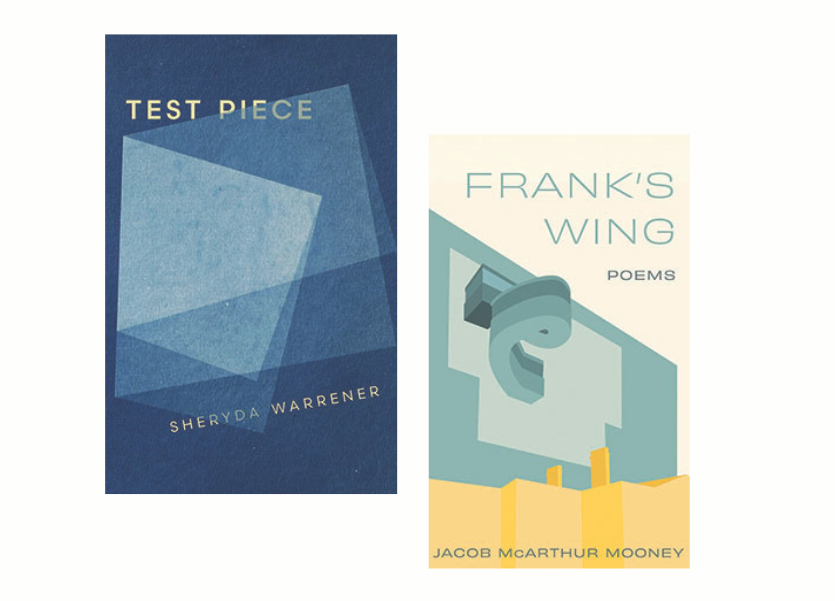
Sheryda Warrener, Test Piece, Coach House Books, 2022
Jacob McArthur Mooney, Frank’s Wing: Poems, ECW Press, 2023
Ekphrasis is a word that means description (in Greek), and it often describes poems that describe art: ekphrastic poems. In some famous cases, this type of poem favours visual descriptions, such as in Keats’s ‘Ode on a Grecian Urn.’ A poem by Rebecca Wolff called ‘Ekphrastic’ begins: ‘I want to see/I want to see I’m going to look at that and see/I want to go up and see.’ Typically, the object of poetic ekphrasis is revealed through the speaker’s hungry looking, which also, often, betrays a desire to be moved by the fantastic work of art upon which this gaze is turned.
In Sheryda Warrener’s newest collection, Test Piece, it is true that a poet-speaker is often moved by fantastic art objects. It is also true that the objects may or may not count as art before Warrener gets her hands on them. I say hands deliberately because, while such an observation might seem abstract (the poet’s imagination turns the ordinary extraordinary), Warrener holds close the materiality of that which she describes. The magnificence of these poems emerges as their capacity to transform aesthetic looking into the tangible, the haptic, the textural—into the perception of fraying edges or soft bodies. These are remarkable poems that animate closeness not by saying what closeness is but by the closing of gaps, the layering of scraps as process. In ‘Crushed Velvet,’ for instance, the enchantment of being a passerby comes from ‘swerv[ing]’ into other people’s orbits ‘On the off chance of catching a wayward spark’; later, we find the ‘Day’s touchlessness reversed’ by the over-the-counter ministrations of a beauty consultant. On a day spent alone-but-together in the city, intimacy might be a stranger smoothing serum onto one’s skin before wiping it away to reveal ‘the gift’ of one’s ‘own hand.’ The piece that follows, ‘Interior Portrait [a haptic experience],’ is a sort of poem-collage, comprising layers of images and words. Here the language of ‘crushed velvet’ returns, typed onto a crushed slip of paper like the contents of a discarded fortune cookie, laid over a photograph of a bed depressed into a body-shape that barely registers. The first is a poem on the move, closing in on other people at pace; the second, a record of stiller impressions that captures, nevertheless, a space for shaping everyday intimacies into art.
‘Interior Portrait [a haptic experience]’ is one of four poem-collages that I initially took to be examples of ‘test pieces,’ or what Warrener calls, in her final, titular poem, ‘a record of an experiment/with unconventional materials.’ All the poem-collages are small and postcard-like, confined to a single page, and they alternate throughout the collection with the free-verse poems to which they seem both preparatory and responsive. Each poem-collage is called ‘Interior Portrait [something]’ and each literalizes tactility as poetic process by pasting words into place, or by overwriting typed words and images with long-hand script. And, as they interrupt poetic reading with a form of attention that includes reading but is more like looking—now, suddenly—the other, more ‘usual’ poems start to seem like surfaces that are worth looking at, or looking into, too. By the alternation of poem-collage and poem, poem-collage and poem, I’m gently prodded into an awareness that every poem is laminated and composite, no matter if it shows off the evidence of that process or not. So, my first impression is revised. All the poems are experimental records whose unconventional materials include (to name a few of Warrener’s specific concerns) rituals, journeys, friendship and art.
Being goaded into such an awareness prepared me (though it did take multiple readings) for finding satisfaction in the compression and airiness that, croissant-like, layering creates. For instance, about the third time I turned from ‘Interior Portrait [what it feels like]’ to the next poem, ‘Test Piece,’ a particular set of images seemed to open up for the first time. The set begins with the poet’s recollection of a workshop about ekphrasis, which takes place on the Zoom grid; the poet reflects on Agnes Martin’s grid paintings; she includes a textbox that represents, like a sticky-note, a ‘fragment’ of her own thoughts on seeing the artworks, as well as on lines excerpted from an interview with Martin that the poet has ‘selected to share’ in the workshop. In ‘the drawings I love,’ notes the poet, Martin ‘leaves evidence/of process fraying/the grid’s edge.’ Earlier in the same poem, ‘ Cut-up/lines float on the flat top of the grand piano’ and their sliced-edges vibrate with a buoyant potential. The strips of paper are grid structures not yet organized along those lines. Tarrying with these images, I feel I am discovering a way to read from this poem back into the creation of the poem-collage that precedes it. In ‘Interior Portrait [what it feels like],’ there is a photograph of a piano covered in 8½ × 11-inch sheets of paper whose in-between spaces are, provisionally, a grid. Finally, such experiences are why I will keep returning to Warrener’s collection, whose individual poems refract new light in relation to one another. As a complete collection, Test Piece invites forms of poetic attention that encourage readers to weave together insight after insight into a patchwork of discoveries—or something more fleeting, perhaps: intuitions or sensations—that are forever almost grasping the brilliant whole.
Jacob McArthur Mooney’s Frank’s Wing: Poems is also a collection animated by relations between poetry and art. The title refers to the wing of a major gallery endowed by Toronto businessman and philanthropist Frank Schumpeter. The collection is split between two categories of poem. On the verso of the Table of Contents are listed the Alta Vistae poems: poems engaged both with the growth of the city, to which Schumpeter’s architectural vision and capital investments have overwhelmingly contributed, and with the growth of the poet under capitalism as a man, a father and a poet. On the recto are listed poems labelled Reconstruction Efforts. Describing works of art that the poet has ‘never seen,/and cannot expect to see,’ the Reconstruction Efforts are what Mooney calls ‘ghost ekphrastics.’ For example, ‘Triptych of the Lost Kandinskys’ and ‘von Neumann’s Unfinished.’ Like Warrener, Mooney has chosen to alternate the two different categories of poem. One effect of this structure may be to demonstrate how financial power and cultural power are two sides of the same coin. Another may be to situate the poet’s attempts at art’s disinterested contemplation amidst the other, interested claims on his time and attention. The Schumpeter figure has bad taste, and yet he has helped to make a city and to fill it with things for people to look at, and at which people cannot help but look.
Spoilers to follow. Although, by way of a lead-in — stop reading now if you’d prefer to be surprised—I’ll start by saying that, yes, Mooney did keep me in a state of suspense by preventing me from doing my usual thing, which is to read the acknowledgements first. The final entry in Frank’s Wing is not really a poem but a series of revelations disguised as a poem in order to prevent readers like me from sniffing it out. ‘I’m worried you might read this first,’ he writes, ‘and that would be a kind of nudity. A show of cards/and source deceptions.’ The first reveal explains why I’d not heard of Schumpeter before, even though his influence appears to be well documented: Schumpeter doesn’t exist. Mooney invented him and all his landmarks—including the Schumpeter Wing, Schumpeter Park and Frank’s highway—as stand-ins for places in Toronto, built and unbuilt: the AGO’s South Gallery, Grange Park and the Spadina Expressway. Of course, even knowing he’s a figment, Schumpeter doesn’t feel unreal. He is a particular type of self-made man of the 20th century for whom love and ownership go hand in hand. In the opening poem, Schumpeter’s ‘ambitions’ include ‘To be his second city’s richest man,/to buy his beloved Leafs and win a Cup,/and to grow the richest art array in all of dour Canada.’
If Schumpeter is unreal but knowable, is the poet whose perspective shapes the rest of the Alta Vistae poems real but unknowable? Maybe. In his ‘show of cards’ Mooney draws his autobiographical and poet selves into alignment, writing, ‘the kid in the Disneyland poem/will be forty this summer./This means that we both made it.’ The screen between now and then is patinaed with memories and the fear of forgetting or missing out; with newfound wisdom that often slips into skepticism about life under late capitalism; and with nostalgia for the naiveté that made possible the pure enjoyment of entertainments like superhero movies and Disneyland. A poem I like a lot is called ‘Nostalgia Man Rises.’ In it, Mooney recalls the genres of an eighties childhood with equal parts cynicism (over the commodification of stories) and wistfulness (over the meaningful identifications one might forge with the same). In this and other reminiscences, Mooney contemplates the ways a single lifetime is too long to keep fresh all the experiences that formed you, but too short to do and see all there is to do and see—particularly if one’s goal is to appreciate great works of art. In the Reconstruction Efforts, then, there is a sort of insouciant perversity to Mooney’s spending what time he has on art that does not exist. And yet, for the poet to invest time, that most precious substance, into the invention of artworks that will never be commodified or financialized, will never appreciate in value, that might be the anti-capitalist answer to Frank’s Wing that only a poet has the power to create.
—Carmen Faye Mathes