

“Never Trust Any Writer’s Explanations About Process or Anything Else”: An Interview With Tim Bowling
As a small boy, Tim Bowling liked to dream about one day publishing a collection of short stories. Fifty-five years later, his dream has come true! The author of 24 other works of poetry and prose, and a recipient of many honours (including five Alberta Book Awards and a Guggenheim Fellowship), Bowling grew up at the mouth of the Fraser River and now lives close to the banks of the North Saskatchewan River.
Marie-Ange Horn: Graveyard Shift at the Lemonade Stand is your first published collection of short stories, even though you’ve been publishing for over 30 years. Did you write these stories recently or is this a collection that has accumulated over a long period of time?
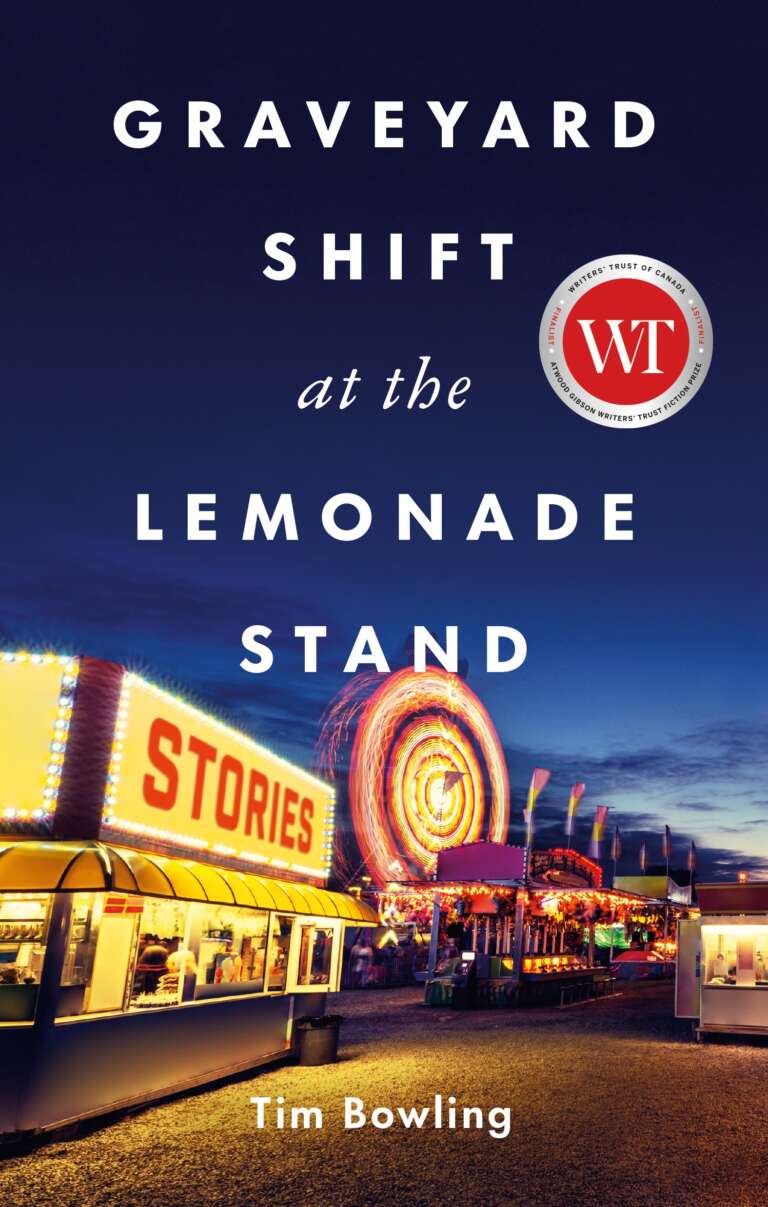
Tim Bowling: Of the 14 stories in the collection, eight were written in the past few years, four shortly before that, and two over a decade ago. Of course, I consider the most recent stories to be stronger, but what writer doesn’t need to believe in personal artistic progress!
Horn: What first attracted me to your book were the nostalgic and melancholic vibes that evoked a certain amount of grieving for childhood and the unavoidability of the passing of time. The stories within this collection seem to follow suit, but none mention a ‘lemonade stand’ or ‘graveyard shift.’ In an interview with Barbara Pelman, you mention how you love coming up with titles. What inspired the title Graveyard Shift at the Lemonade Stand, a title that matches the collection beautifully, yet is not a direct reference to any of its stories?
Bowling: Nostalgia, melancholy, grieving for childhood and the passing of time. Guilty as charged! And thank you for being attracted to these qualities, as they aren’t every reader’s cup of tea (or indeed, glass of lemonade). But I would like to point out the counterbalance in the collection: the humour, the irony, and the love of nature and art. With regards to humour and irony, the title is an attempt to capture those aspects of the book. The sweetness and innocence we associate with an ideal childhood colliding with what Philip Larkin described as “the toad, work,” and the moral complexities and heartbreaking losses we associate with growing older being tempered by nostalgia for a simpler time (often spent outdoors). Oh, and you’re right that there is no direct reference in the stories to the title, but a lemonade stand is mentioned in “This is a Test of the Emergency Book-Buying System,” a story almost entirely composed of jokes, as is “Bartleby, the Sessional” and a couple of others. Melancholy, after all, is a close companion of humour—indeed, of the absurd.
Horn: In a 2024 interview with Hollay Ghadery, you discuss the concept of “premature grief” as the joy of the present moment being out of grasp because of the realization of a moment’s temporary nature. This is a feeling that resonates within many of the stories in this collection. When I was reading them, I felt an almost nostalgic grief for experiences I had never had but still found deeply relatable. Was this part of your intent when writing this collection? Are these stories, for you, an expression of premature grief?
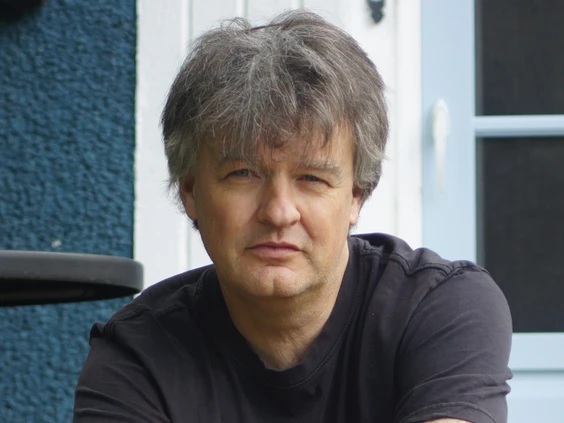
Bowling: Oh, probably, yes. I was a rather contemplative little boy (as you can see in my author photo) with a weighty sense of time, death, and change, likely the result of having parents old enough to be my grandparents, of having an intimate relationship to nature (my family worked in fishing and farming), and of having a naturally melancholic disposition. But I can’t say that I ever set out with a particular intention when it comes to theme or mood. My focus is more technical, a matter of trying to engage the reader and build a compelling narrative by using all the tools in the writer’s toolkit–imagery, characterization, pacing, etc.
Horn: Looking at characterization, some of your stories have characters that are disliked for no real reason—like appearing too interested in a young woman’s life, being an awkwardly large boy with an affinity for reading, etc. I found this premise for characters very interesting and would love for you to discuss where that comes from. What were you exploring through those characters and their interaction with a world that didn’t seem to understand or accept them?
Bowling: I suppose that anyone who chooses to be an artist has already stepped outside of societal approval and acceptance and therefore has empathy for other humans in the same situation. But I generally construct my short fiction, as well as my novels, poetry, and nonfiction, much more along technical lines. That is, what is going to best serve my dramatic purpose, my attempt to entertain and move the reader? Characters that fit comfortably into the world they inhabit can be interesting, and certainly people that appear ordinary are often extraordinary in different ways, but the inherent isolation of the outsider does lend itself to the kind of dramatic situations that I favour. Then again, when I think of these stories, I realize that many of the central characters are ordinary in the sense of seeming so from the outside, but that their conflict usually stems from an internal struggle or from an external impetus in the form of a more obviously alienated character.
Horn: I think that is what makes these characters so relatable. Your imagery in these stories is also very pronounced. In a 2017 interview with Rob Taylor, you mention your process for writing poetry, saying “Almost always I begin my poem with a rhythm or an image; rarely with an idea.” Was your process for these stories similar to, or different from, your process for poetry?
Bowling: Did I say that about poetry? Agh, never trust any writer’s explanations about process or anything else. Seriously. It’s usually only half-truths at best, subject to change for any number of reasons. The best thing I can tell you is that the creative impulse is mercurial and will latch on to whatever works at the moment. I was probably making one of my periodic digs at didactic and academic poetry, since I’ve almost always considered the best poetry to be a blend of sonic effects and authentic feeling rather than this political stance or that linguistic theory. With short fiction, it’s different, though I believe that the relationship between poetry and the short story is stronger than the relationship between the short story and the novel. Where the poem is apt to lean on sound and metaphor to build intensity, the story generally leans on situation and character. But in both genres, there’s an urgency, an attention to detail, and a sort of epiphanic payoff that makes them cousins if not quite siblings.
Horn: Graveyard Shift at the Lemonade Stand is currently on the shortlist for the Atwood Gibson Writers’ Trust Fiction Prize. You have received many prestigious honours, including multiple Alberta Literary Awards, a Guggenheim Fellowship, and national prize nominations. In that interview with Taylor, you also spoke about how awards are encouraging but ultimately peripheral to your work. How do you feel about being on the shortlist for the Atwood Gibson Writers’ Trust Fiction Prize? Is there an award or prize that, if you won it, might feel more than peripheral?
Bowling: No, I don’t think so. But please let me be clear: awards and honours are NOT peripheral to my life and livelihood at all. In fact, they’ve been central. I’m immensely grateful for them. My earlier comment about awards focused on how they affected my sense of my own work or my approach to it, which they never have. The task I set myself as a young writer—to create literature out of my own physical surroundings and experiences, mainly on the south coast of BC and in Edmonton—is the task I’ve always worked at and will continue to work at. And without question, this nomination for the Atwood Gibson Writers’ Trust Fiction Prize gives me a lovely feeling that three jurors of my peers see my task as worthwhile. Plus, I’m getting on in years, and our society isn’t too friendly to older folks, not even in the arts, so any kind of visibility is a welcome surprise. Of course, our society’s not all that friendly to young adults either, but I can’t speak for them, no longer being a member of that guild.
Horn: I’d like to circle back to the relationship between short stories, novels, and poetry, and the sibling closeness of them you mentioned earlier. Faulkner once said, “I’m a failed poet. Maybe every novelist wants to write poetry first, finds he can’t, and then tries the short story, which is the most demanding form after poetry. And, failing at that, only then does he take up novel writing.” This suggests to me that there is a hierarchy between genres (with poetry at the top and novel writing at the bottom). As a writer who can clearly write well in all three as well as non-fiction, and enjoys blurring the line between genres, what are your thoughts on this?
Bowling: Faulkner, like so many famous authors, was a real character, a regular con artist much of the time. When I was young, I loved his line about the mercenary nature of writers, that they’d do anything to get their stories, even murder their own mothers. I think he said something like, “Keats’s ‘Ode on a Grecian Urn’ is worth any number of old ladies.” Hilarious. And hilariously wrong, of course. He’s also wrong about novel writing. Certainly our culture doesn’t agree with him, as it has novels generally at the top, with short stories very far below, and poetry so much farther below that as to be almost invisible. But I suspect he meant great poetry. Even then, I doubt that great poetry is very demanding to the great poet, who obviously would love everyone to think so. I mean, great poetry is obviously rare, but then, so is great short story and novel writing. To summarize, I refer you to my earlier answer about taking writers on writing with a big heaping of salt. Faulkner also famously said that he considered all his novels to be failures. I take his point—that a writer can never fully capture the life he wants to convey—but I have a feeling he had a higher opinion of his books than he was letting on.
Horn: You do a great job at capturing life in these stories. Not just the characters, and poetics, but the melancholy and humour of life that hold a balance towards the absurd. When I was reading Graveyard Shift at the Lemonade Stand, I couldn’t help but think of Camus. His philosophy really came down to the meaningless of life and how there are three main responses to that understanding: suicide, religion, and the one he prescribed to—embracing the absurd and making our own meaning out of the lives we live. Your stories resonate with this third sentiment to a certain extent. I was happy, then, to see you mention being a fan of Camus in an interview with David Brundage, in 2014. How much Camus philosophy actually influences your writing, if any at all?
Bowling: Peter Cocking, the graphic artist who designed Graveyard Shift, as well as my 2024 poetry collection In the Capital City of Autumn and my 2023 novel The Marvels of Youth, always springs to mind when that French Algerian author/philosopher comes up. Peter would say, “I can row a boat. Camus?” Now, if that isn’t absurd, what is? I’m sure Camus, especially if he understood Canada and the role of the canoe in our country, would agree. While I’m not the world’s most fervent reader of Camus, I have read The Outsider many times, as well as The Myth of Sisyphus, and I do subscribe to an absurdist view of life in which we’re responsible for creating our own meaning, a meaning that is, however, built, as Camus insists, on justice and empathy.
Horn: In that interview with Brundage, you also mentioned how all poetry is really about time. The stories in this collection are thematically about the passing of time, aging, and transformations. Has your concept of time changed since your first book in 1995, and if so, how has that then changed your writing?
Bowling: Tick, tick, tick. There go a few more seconds. Grab them and try to hold them. You can’t. And as you get older, your desire for holding onto time increases as the strength of your grip decreases. If anything, I’m more time-haunted now than ever, more aware of the ephemerality of everything, more aware of the sheer astonishment at being alive, which of course makes it rather difficult to live with the hurly-burly of the speedy, distracted, often mean-spirited world. So how can an aging person hold on and celebrate as the final darkness approaches? One way is through art. I now feel a greater urgency to record my experience of the complicated mystery of being alive. Why? Sometimes it’s out of a desperate need not to succumb to gloom and doom, sometimes it’s out of a noble impulse to give back some of the pleasure to readers that I have received as a reader from hundreds of authors myself, and sometimes—I’ll be frank—it’s out of my keen awareness that I’m not good at anything else.
Horn: And you don’t just give back to readers, but to future writers as well. You have been a Writer-in-Residence in many institutions and have much experience with student writers. In your opinion, what is the best and worst advice for student writers?
Bowling: Oh dear, that’s so hard for me to answer, mostly because advice from other writers is largely useless, especially from older writers. But I’ll try. The obvious best advice is to read voraciously without analyzing what you’re reading. Be as much of the child-reader you were as possible and avoid approaching poems and stories like a terminal grad student or cynical professor. Try to avoid fashion for fashion’s sake, especially if older people are peddling it to you, and especially if it’s “clever.” More importantly, DO NOT go into debt to obtain a creative writing degree. The average income from writing earned in Canada has decreased over the past 20 years (it’s down around 7k) as the cost of living has skyrocketed. Worst advice? Avoid adjectives. Adjectives can be breathtaking. In fact, everything in the language can be your ally, even if, as Adrienne Rich put it, you have to use “the enemy’s language.” As for strictly practical advice, I don’t have much. The path is different for every writer, and fate is fickle. Also, when I was starting out, there was no AI and we still had large publishing houses that were Canadian-owned. The landscape is too different for me to address. But if you can, it does help to work in multiple genres, if for no other reason than to give yourself a break from one kind of challenge to turn to another.
Horn: This last question is more out of personal interest and curiosity, but in an interview with Nigel Beale, you talk about your love of book collecting and mention that for you a book with a personalized association is more valuable than a rare first edition with no association. As a beginner collector myself, I would love to know, what is currently your most “valuable” book?
Bowling: Are you sure you want to ask me about my book collection? Are you absolutely sure? I’m never asked, so I could go on for pages about the subject. In fact, I might even write another book about it (my 2010 nonfiction title In the Suicide’s Library: A Booklover’s Journey explores book collecting at some length and with weirdness). Ok, I’ll restrict myself to my latest acquisition: an unremarkable Modern Library printing of one of the volumes of Proust’s seven-novel epic (The Cities of the Plain) with the ownership signature and extensive bizarre, almost unreadable annotations and doodles by the American poet Delmore Schwartz! I also have a collection of F. Scott Fitzgerald’s Letters inscribed by his daughter Scottie. And…I’d better stop. Honestly. It’s dangerous to ask a hermit-like book collector about his most “valuable” books. Did I mention my copies of Tomas Transtromer’s early collections inscribed in Swedish to his friend and translator Robert Bly and in which Bly has handwritten his English translations of the poems? That I bought them for very little from an online dealer who had no awareness of the importance of the Transtromer/Bly friendship to twentieth century poetry? Or what about the anthology of poems written to celebrate Gordon Lightfoot that contains the signatures not only of several contributing poets but also of the singer-songwriters Ron Sexsmith and Gordon Lightfoot himself! See what I mean. I could go on forever. Well, until time destroys all remnants of my lemonade stand, which it will. And on that melancholy note . . .
Marie-Ange Horn is currently completing a bachelor’s degree in English at the University of Fraser Valley.