
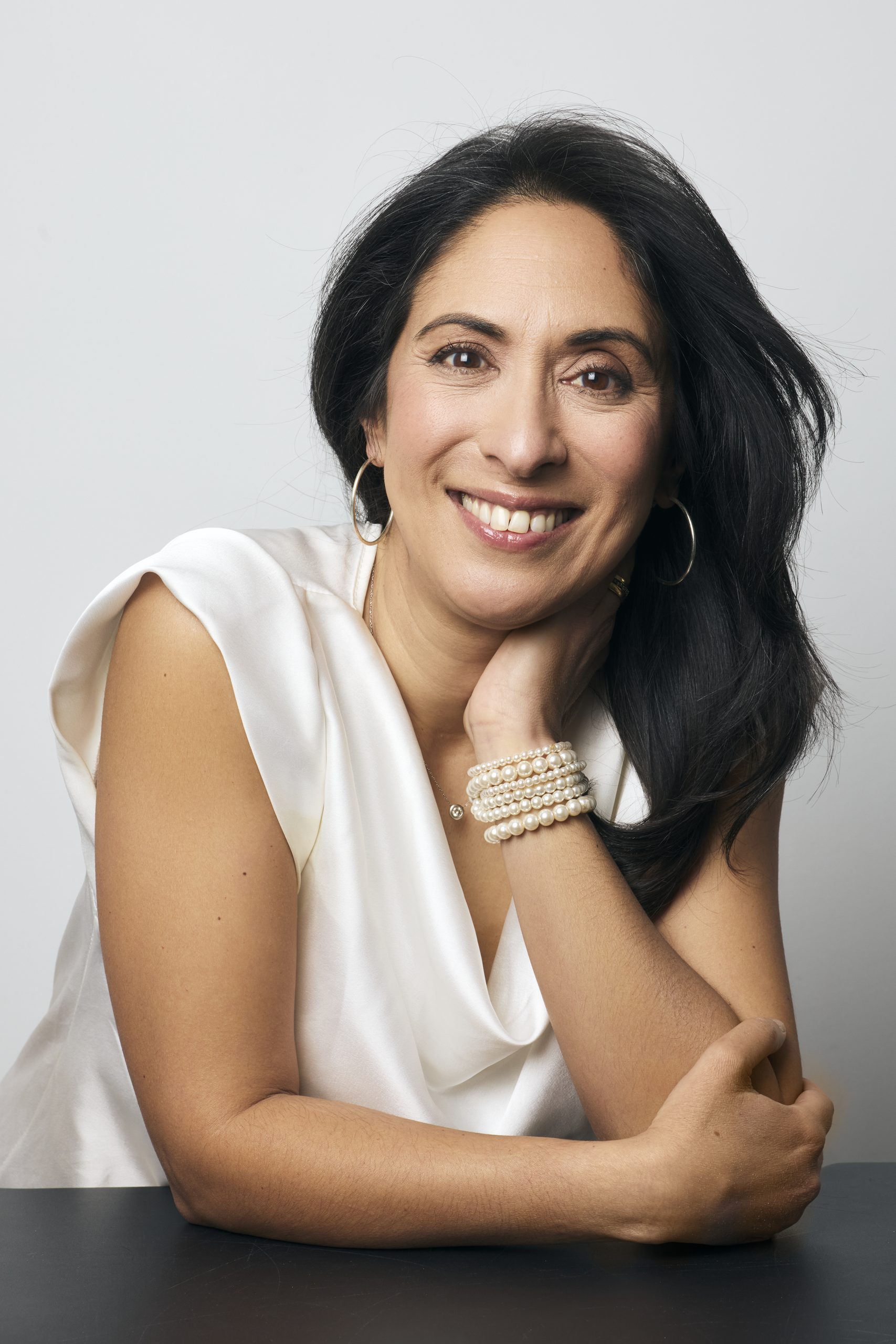
MINELLE MAHTANI is a Muslim Iranian/Indian/Canadian writer, former TV producer and radio host. She is Chair of Canadian Studies at the University of British Columbia. Her memoir, May It Have a Happy Ending has been called a “magnificent and stunning debut.” It won the Hubert Evans Prize for best non-fiction of the year. She has been nominated for two National Magazine Awards and won a gold medal for best personal essay in the Digital Publishing Awards. Mahtani is also the author of the book Mixed Race Amnesia: Resisting the Romanticization of Multiraciality. Her work has appeared in The Walrus, Geist, Maisonneuve and Southeast Review. She is currently working on a book about erosion with UBC Press.
OLIVIA MACDONALD: As this year’s EVENT Non-Fiction Contest judge, I’d love to hear a little more about your relationship with creative non-fiction. What first drew you to the form, and what keeps bringing you back to it?
MINELLE MAHTANI: I never thought I would write a memoir! Who was I to write my story? Why would it matter in the world? As a journalist, though, I always kept returning to question how my own experience of a place or of a person influenced my writing. I realized early on, when I started at the CBC, that I was always going to question objectivity—as if such a thing could ever really exist. I’ve also never been drawn towards academic writing, even though I’ve been a professor for more than twenty years now. I’ve always found it to be terse and cold. I wanted to ask if there was another way to communicate complex ideas through less rigid and ritualistic forms of communication. How many times can we use a colon in the title of an article? Why do we use moreover so much? I am joking but only a little. I think CNF opens up an entire different space for me to be vulnerable while still communicating clearly. There’s a freedom in CNF that doesn’t exist in academic writing and that doesn’t mean there are no rules; rather, it means that we can find more creative ways of expressing ourselves.
OM: You move between personal narrative, journalism, and scholarship, each of which involves a different relationship to research and evidence. When you’re developing a personal essay, how do you decide when an idea or memory needs more research and when the research might start getting in the way of the narrative? Is finding that balance something you’ve had to learn?
MM: Oh, I find that I almost never stop researching. That compulsion never leaves me! I have spent decades researching topics. I remember conducting a quantitative analysis of the kinds of questions posed to child victims of sexual abuse to a full-length study of the reasons why mixed-race women refuse to categorize themselves as half-white at particular moments in their lives—and so I’m always curious to dig deeper, to see what others have said about similar topics before I start writing. I can’t say I’ve ever found that the research gets in the way of the narrative—rather, I sift through the material and allow the narrative to surface on its own: I feel like a prospector searching for gold in the silt. The story almost always makes itself known.
OM: You recently led a workshop with Geist focused on writing what we cannot fully remember. What can a writer do when they remember the emotional force of an experience but are uncertain about the details? Do you have any advice on how to embrace that uncertainty as part of the writing?
MM: I absolutely love this question because when I was on book tour, so many people approached me timidly, wondering how I could so vividly remember everything that I shared in the book. I have a terrible memory—or so I thought!—but in writing my memoir I focused on the particularities of the moments I was trying to convey. The scent in the room, the light on the pine table. It’s moving from the particularities—capturing the immense joys of intricate geographies—that lead to the more fulsome telling of the story.
OM: Similarly, the title of your memoir May It Have a Happy Ending raises the question of what a happy ending might mean. How do you recognize where and how a piece should end when the experience itself still feels unresolved?
MM: I really believe in the power of creative serendipity. You can’t force an ending. Neither can you force a beginning. I recommend that folks build a book altar and pray to whatever God feels right to you in order to summon all your creative spirits to support you. It’s one way to recognize that the story is in you—it just requires summoning! For my memoir, I received the most beautiful advice from Gail Gallant, a writer I admire greatly. She said, try to end on a high note, so as a writer I also end with a happy ending. I’m so glad I did that, because so many memoirs tend to end in a melancholic tone. I’ve also been grateful to the spirits in my writing world for offering me the ending of my new book before I had even penned the first page! I am using that inspiration as I write my next project, a novel called Fall from Grace.
OM: With your upcoming Harold Innis Lecture, “Erosion: Uncertainty at the End of Stability,” and the book on erosion you’re currently working on with UBC Press, I am curious what drew you to that subject, and what has it asked you to try differently as a writer?
MM: Ah, erosion! Yes! I trained as a geographer and so erosion as a topic has fascinated me since my early days doing field work as an undergraduate at McGill. But I had never thought about erosion beyond a physical process; of contemplating the land wearing down. In this talk I focus on bodily erosion and national erosion; working from my own recent medical diagnosis to thinking about the erosion of relationships in a time of AI and the erosion of democracy. I particularly focus on questions of media ownership. But I also speak about the loss of a loved one in this talk—a gorgeous, lumbering sheepadoodle named Boomer. I am still working on the talk and am terrified that it won’t come together—but I have to turn to my altar again!
OM: Have any of your pieces gone through a particularly significant revision? How did the piece change from what you originally intended to write to the final version, and how did you come to recognize what the piece needed? For someone writing their own essay, what are some things they can look for when they feel like a piece isn’t quite working yet?
MM: Of course, everything I’ve ever published has gone through significant rewrites! My agent laughs and says the draft we submitted to Penguin Random House looks absolutely nothing like the one we ended up with, and he is right. My editor would mark up my work to the point where there was more red on the page than my initial words! And rightly so. The best advice I have for those writers—either starting out or those who have published many pieces—is to read your work out loud. That’s where you find the glitches. Read it into your iPhone and then go listen to it. You will hear what isn’t working on the page.
OM: In an interview with The Georgia Straight you spoke about Anne Michaels’ influence on your thinking about grief. Is there a particular craft lesson you have taken from her work into your own? Do you have any other literary role models that have inspired your writing?
MM: In responding to this question I feel a great deal of reverence in even seeing Anne’s name on the page. One of the many gifts in sharing my memoir with the world has been developing a relationship with Anne. I had the good fortune to interview Anne Michaels at Vancouver Writer’s Fest when my book came out. Just before we went on stage, she asked for a minute with the audience before I began. She then turned to the audience and said, “I would like to share a few words with you why I think Minelle’s book is beautiful.” That act of generosity took my breath away. It reminded me of the importance of always recognizing one another, even in something as simple as an interview—an interview, of course, always being complicated, as I speak about in my book!
Anne’s work is ultimately about erosion, too—and she speaks with a precise poetry about geological concepts and what the writer Catalina Botez identifies as “liquefactions”—depicting cataclysmic metamorphoses of landscape. In fact, Anne’s work will appear in my new book. Anne Michaels has taught me so much, but in particular her writing has encouraged me to take risks in writing feminist geographies with care, generosity and precision. I also admire the work of Andre Dubus the III who has been a mentor to me as I work on my new novel, and I’m looking forward to speaking with Ayad Akhtar at Vancouver Writers Fest soon—his new book The Radiance is hilarious and spellbinding.
The deadline for submissions to EVENT’s 2026 Non-Fiction Contest has been extended until November 1, 2026. The three winning entries will be published in EVENT, and all entries on the short list will be considered for publication. Minelle Mahtani is this year’s guest judge.
OLIVIA MACDONALD is the Magazine Intern at EVENT. She is currently completing a Master of Publishing at Simon Fraser University and is co-editor-in-chief of Bitter Magazine.